
Why Do Small Dogs Live Longer Than Large Dogs?
A plain-language guide for dog owners — real science explained simply, with actionable tips to help your dog live a longer, healthier life
If you have ever noticed that your neighbour’s tiny Chihuahua seems to keep going for years and years while a much larger Great Dane or Saint Bernard ages and slows down far too soon, you are not imagining things. Small dogs genuinely do live longer than large ones — and the reasons behind it are fascinating.
The good news is you do not need a science degree to understand why. In this guide, we will walk through exactly what is happening inside your dog’s body in clear, everyday language. We will also cover what you can do to give your dog — no matter their size — the best possible shot at a long, happy life.
The Size Puzzle That Surprises Most People
Here is something that trips people up at first: across the animal kingdom, bigger animals almost always live longer. An elephant can live for 60 to 70 years. Blue whales can reach 80 or more. Even among birds, large cockatoos can live up to 80 years, while tiny sparrows survive for only about three.
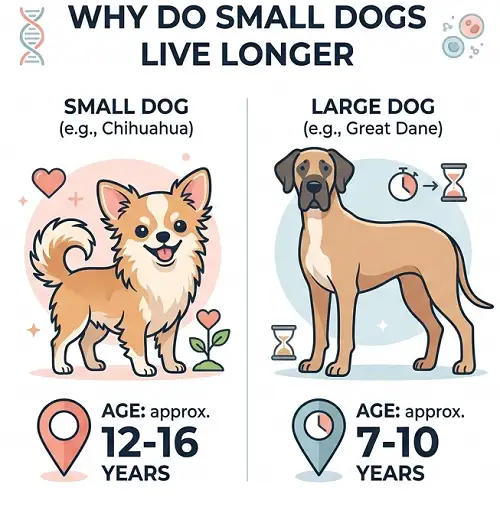
So you would expect a 150-pound Great Dane to outlive a 6-pound Chihuahua by decades, right? But that is the complete opposite of what actually happens. A Great Dane is doing very well to reach 10 years, while a Chihuahua can comfortably live past 15. Scientists who study animal biology call this “the dog size puzzle” — because dogs break almost every rule we have about size and lifespan in the animal world.
Understanding why takes us into some genuinely interesting territory. And the answers have real, practical meaning for every dog owner.
What the Research Actually Shows
Scientists have not just guessed at this — they have studied hundreds of thousands of dogs across hundreds of breeds to find solid answers. Here is what the biggest and most reliable studies have found:
The Kraus Study
- Looked at over 56,000 dogs across 74 different breeds
- Found that for every extra 4.4 pounds a dog weighs, they lose roughly one month of life on average
- Concluded that large dogs “die young mainly because they age quickly”
The Urfer Study
- Analyzed data from an impressive 169,000 dogs
- Confirmed the strong, consistent link between larger size and shorter lifespan
- Found that annual professional teeth cleanings reduced a dog’s risk of dying by 20%
University of Washington
- Studied 25,000 dogs across 238 different breeds
- Confirmed that smaller dogs consistently outlive larger ones
- Found that different-sized dogs have different health risks — not that large dogs are simply less healthy overall
The Dog Aging Project
- An ongoing, large-scale research project tracking thousands of dogs over many years
- Studying exactly what helps dogs live longer and healthier lives
- One of the most ambitious dog health projects in history — and still adding new findings
Across all of these studies, the numbers tell a very consistent story:
| Dog Size | Typical Weight | Average Lifespan |
|---|---|---|
| Small | Under 20 lbs (9 kg) | 13 – 16 years |
| Medium | 20 – 50 lbs (9 – 23 kg) | 11 – 14 years |
| Large | 50 – 90 lbs (23 – 41 kg) | 10 – 13 years |
| Giant | Over 90 lbs (41 kg) | 7 – 10 years |
Every dog also moves through distinct life stages — from playful puppy to settled adult to slower-paced senior — and the speed at which they travel through those stages is very different depending on their size. For a full breakdown of each stage and what to expect, see our dog life cycle guide.
4 Simple Reasons Why Small Dogs Live Longer
There is not just one single cause. Several things happen at once inside a dog’s body that together explain why small dogs live longer lives. Here is each one explained in plain, everyday language.
1. Growing Fast Comes at a Hidden Cost
Think about how fast a Great Dane puppy grows. In just 18 months, it can go from a tiny newborn to a 150-pound adult. That is an almost unbelievable amount of growth in an incredibly short time. A Chihuahua puppy, by comparison, might only grow from a few ounces to about 6 pounds over the same period — a much gentler, steadier journey.
All of that dramatic, fast growing in large breeds is powered by strong signals inside the dog’s body that tell its cells to build, grow, and multiply as fast as possible. Large dogs have very high levels of these signals from birth. Small dogs have far lower levels.
Here is the critical part: the same signals that make big dogs grow so quickly also speed up how fast their body cells age. The faster cells are pushed to grow and copy themselves, the sooner they start to wear out. It is a bit like running a phone battery at 100% brightness all day every day — it will wear out much faster than a battery kept at 40% brightness.
Small dogs, growing slowly and steadily, keep these signals at a low and sustainable level. Their cells multiply gently, and as a result, they age gently too.
2. Wear and Tear Builds Up Inside the Body
Every time your dog’s body uses energy — running, breathing, digesting food, keeping the heart beating — a very small amount of waste material is produced inside the cells. In tiny amounts this is perfectly normal, and the body handles it easily.
But in large dogs, with their bigger bodies running at a much faster pace, this internal waste builds up faster than the body can fully clear it away. Over months and years, this gradual build-up starts to slowly damage the cells from within — a bit like rust quietly forming on a piece of metal that is never properly cleaned.
Once a cell is damaged in this way, it either stops working as well, or in some cases starts behaving in ways that cause serious health problems. Small dogs, with smaller and slower-running bodies, produce far less of this internal waste. Their cells stay cleaner and healthier for much longer.
3. The Way Their Bodies Use Energy Is Different
Smaller dogs actually burn energy more efficiently than larger dogs — pound for pound. Imagine two vehicles: a small city car and a heavy-duty truck. The truck uses far more fuel per trip. But looking at fuel efficiency per pound of the vehicle’s own weight, smaller vehicles tend to be noticeably more economical.
The same principle applies inside a dog’s body. A large dog’s system burns through its internal fuel resources at a faster and less efficient pace than a small dog’s does. This faster, harder-working internal engine contributes to the cells of larger dogs getting tired and worn out sooner.
Small dogs, with their steadier and more efficient internal systems, simply do not put the same daily strain on their bodies. And that difference compounds over the years into a meaningful gap in lifespan.
4. Large Dogs Live Life on Fast Forward
Perhaps the simplest way to think about it: large dogs live their entire lives as if someone pressed the fast-forward button from the moment they were born.
They grow up faster. They hit their prime faster. They reach middle age faster. And unfortunately, they begin slowing down and showing signs of old age faster too. A Great Dane at 5 years old is already considered a senior dog. A small Toy Poodle or Beagle at 5 is still very much in the prime of their life.
This is not just about how the dog looks or behaves on the outside. Their internal body clock genuinely runs at a faster speed. The aging process itself is accelerated from birth and continues throughout their entire life.
Source: University of Melbourne — Evolutionary Biologist Prof. Mark Elgar
Think of It Like a Car Engine
Professor Mark Elgar, an evolutionary biologist at the University of Melbourne, offered one of the best plain-language explanations of why this happens:
“Modern cars generally work well for eight or nine years, and then wear and tear sets in and they start falling apart. The speed with which they deteriorate varies between manufacturers. It is the same with dogs.”
Think of a small dog as a reliable economy car — built to run efficiently at a comfortable, steady speed for a very long time. Think of a large breed dog as a high-performance sports car pushed hard every day — impressive and powerful, but under significantly more stress with every passing mile.
Both are well-made. Both can be loved and well-maintained. But the one that runs harder, every hour of every day, from the very beginning — will wear down sooner. That is not a design flaw. It is simply physics.
Prof. Elgar also made another point worth remembering: dogs are unique in the animal world because human breeding over thousands of years has pushed their body sizes to extremes. The smallest and largest dog breeds differ in body weight by up to 50 times. No other species shows anywhere near that level of size variation within a single species. And that extraordinary range in size is exactly what drives the extraordinary range in lifespan.
Why Large Dogs Face a Much Higher Cancer Risk
One of the biggest reasons large breeds have shorter lives is cancer. Research consistently shows that large dogs are two to three times more likely to die from cancer than small dogs. This is one of the most clearly documented differences between large and small breeds in veterinary studies.
Here is why, in simple terms. Cancer begins when a cell starts copying itself incorrectly and simply does not stop. Every time a cell copies itself, there is a tiny chance that something goes slightly wrong in that copy. The more times cells copy themselves, the more chances there are for something to go wrong.
Because large dogs are driven to grow and multiply their cells so rapidly — from puppyhood and throughout their lives — there are far more of these copying events happening inside a large dog’s body than a small one’s. More copying events mean more opportunities for an error to creep in and turn into a serious problem.
It is a little like photocopying a document 10,000 times versus 500 times. Each copy has a small chance of introducing an error. More copies, more chances for mistakes to appear.
How Long Do Dogs Live? A Complete Breed Lifespan Guide
Below is a detailed breakdown of average lifespans by size and breed. These are typical ranges for healthy, well-cared-for dogs. Individual dogs can live shorter or longer depending on their genetics, environment, and the care they receive.
| Size | Example Breeds | Typical Lifespan | Key Notes |
|---|---|---|---|
| Small Under 20 lbs | Chihuahua, Yorkshire Terrier, Pomeranian, Maltese, Shih Tzu, Papillon, Bolognese, Lancashire Heeler | 12 – 16+ years | Age the slowest of all dogs. Some individuals reach 18 – 20 years. Dental problems are the most common issue to watch for. |
| Medium 20 – 50 lbs | Beagle, Cocker Spaniel, Border Collie, Dachshund, Australian Cattle Dog, Australian Shepherd | 11 – 15 years | Wide variation by breed. Australian Cattle Dogs are a standout — they regularly reach 14 – 16 years. Border Collies also tend toward the longer end. |
| Large 50 – 90 lbs | Golden Retriever, German Shepherd, Labrador Retriever, Boxer, Doberman, Weimaraner, Rhodesian Ridgeback | 10 – 13 years | Cancer rates are significantly higher. Joint problems become common as they age. Golden Retrievers are especially well-known for cancer risk. |
| Giant Over 90 lbs | Great Dane, Saint Bernard, Mastiff, Newfoundland, Irish Wolfhound, Bernese Mountain Dog, Bullmastiff | 7 – 10 years | Age the fastest of all dogs. Considered seniors at just 5 – 6 years. Heart conditions and joint stress are common. Irish Wolfhounds average around 9 – 10 years. |
Wait — Some Large Dogs Live Longer Than Expected
Before you assume that every large dog lives short and every small dog lives forever, it is worth knowing that there are some genuinely interesting exceptions to the rule.
Larger breeds that often outlive expectations:
- Australian Cattle Dog: A medium-to-large breed that routinely reaches 12 – 16 years. The oldest verified dog ever recorded — an Australian Cattle Dog named Bluey — lived an astonishing 29 years and 5 months. Bluey spent his life as an active working dog on a sheep farm, which may have contributed to his remarkable health.
- Siberian Husky: Despite weighing 40 – 60 pounds, Huskies regularly live 12 – 14 years — well above average for their size. Their lean, athletic build and working-dog genetics appear to offer some natural protection.
- Greyhound: These slender racing dogs can reach 10 – 14 years. Their bodies carry very little excess weight and their hearts tend to be extremely efficient.
- Australian Shepherd: A medium-large breed that often lives 13 – 15 years — noticeably longer than most dogs of a similar size.
Smaller breeds that do not live as long as their size might suggest:
- French Bulldog: Despite weighing under 30 pounds, their flat nose and compressed airways make breathing difficult throughout life, which can limit their lifespan to just 9 – 12 years.
- English Bulldog: The same flat-face structure causes similar challenges, with average lifespans of only 8 – 10 years — shorter than many breeds twice their size.
- Pug: Another small but flat-nosed breed averaging around 11 – 12 years, with breathing difficulties often affecting quality of life long before the end.
The lesson here is clear: size is the single strongest predictor of lifespan across all dogs — but it is not the only factor. Genetics, the specific structure of the breed, and how they were bred all play a very real role too.
Mixed-Breed Dogs vs. Purebreds: Which Lives Longer?
Here is something many dog owners are genuinely surprised to learn: mixed-breed dogs tend to live longer than purebred dogs of the same size. This is not just a rumour — it is backed by research.
The American Animal Hospital Association found that mixed-breed dogs significantly outlive their purebred counterparts. And interestingly, the bigger the dog, the more noticeable this gap becomes. For giant breeds especially, having a broader genetic background can make a real, measurable difference to how long they live.
Research also shows that mixed-breed dogs live approximately 1.2 years longer on average than same-sized purebreds. That might sound like a small number — but in dog years, it represents a meaningful stretch of extra healthy life.
The reason comes down to genetic variety. When dogs from different backgrounds mix, their puppies inherit a much wider range of genes. This broader genetic mix acts as a natural protection against the inherited health weaknesses that purebred dogs can be more prone to.
Purebred dogs are bred generation after generation for specific looks, sizes, or abilities. While this selective breeding gives us the wonderful, predictable traits we love in our favourite breeds, it can also accidentally concentrate health vulnerabilities alongside those desirable traits. Mixed-breed dogs, drawing from a wider genetic pool, naturally sidestep many of these inherited problems.
Bottom line: If you have a mixed-breed dog, they likely have a natural longevity advantage. If you have a purebred, that simply means focusing on great care, regular vet attention, and being aware of the specific health challenges common to their breed.
Does Your Dog’s Gender Make a Difference?
Most dog owners are not aware that a dog’s gender can also quietly influence how long they live. It is not a dramatic difference, but research has noted it consistently enough to be worth knowing about.
On average, female dogs tend to live 6 to 12 months longer than male dogs. The reasons include:
- Male dogs tend to be more prone to roaming, exploring, and risk-taking behaviour — which raises the chance of accidents and injuries.
- Certain male hormones contribute to a faster rate of physical wear on the body over time.
- Unspayed female dogs carry a risk of a life-threatening womb infection that can develop suddenly in middle or older age.
However, the biggest gender-related factor — and the one with the clearest research behind it — is whether a dog has been spayed or neutered.
Spayed Female Dogs
- Live approximately 23% longer than unspayed females on average
- Dramatically lower risk of certain reproductive cancers
- Eliminates the risk of a serious, potentially fatal womb infection known to affect unspayed dogs
Neutered Male Dogs
- Live approximately 18% longer than unneutered males on average
- Reduced risk of prostate problems and certain cancers
- Less likely to roam, which directly reduces the risk of road accidents and injuries
For a detailed breakdown of how aging works differently for male and female dogs — and exactly when different breeds reach their senior years — our senior dog age guide covers all of this in depth.
Signs Your Dog Is Entering Their Senior Years
Knowing when your dog is beginning to age is important, because their needs change significantly as they get older. The earlier you notice the signs, the sooner you can adjust their care to keep them comfortable, healthy, and happy.
The timing of these changes depends heavily on size. For small breeds, senior signs typically appear around 10 to 12 years of age. For large and giant breeds, the very same signs can show up as early as 5 to 7 years old — a reminder of just how much faster their internal clock runs.
Common signs that your dog is entering their senior years:
- Moving more slowly, stiffness when getting up in the morning, or reluctance to climb stairs
- Sleeping more than usual, or tiring quickly during walks that used to be easy
- White or grey fur appearing around the muzzle and eyes
- Changes in appetite — eating less, or occasionally more, than before
- Cloudiness in the eyes or a noticeable reduction in sharpness of vision
- Less responsiveness to sounds or commands, suggesting changes in hearing
- Increased anxiety, confusion, or clinginess — especially in unfamiliar situations
- More frequent toilet accidents inside the house
7 Proven Ways to Help Your Dog Live Longer
Understanding why small dogs live longer is genuinely interesting — but what most dog owners really want to know is: what can I actually do to help my dog live as long and as well as possible? Here are seven things that are backed by real research, with the numbers to prove why each one matters.
This one surprises most people — but it is one of the most powerful things you can do. The Urfer study, which looked at 169,000 dogs, found that annual professional teeth cleanings reduced a dog’s risk of dying by a remarkable 20%. That is not a small number.
The reason is that bacteria from gum problems do not stay in the mouth. They enter the bloodstream and slowly damage the heart, kidneys, and other organs over time. Keeping teeth clean is not just about fresh breath — it protects the entire body. For a complete, easy-to-follow guide to your dog’s dental health at every age, visit our dog teeth chart.
Research published in the Journal of Veterinary Internal Medicine found that overweight dogs live up to 2.5 years less than dogs at a healthy weight. That is a significant chunk of life — and it is entirely within your control as an owner.
Carrying excess weight puts strain on joints, makes the heart work harder, increases body-wide inflammation, and raises the risk of serious conditions like diabetes. The key habits are simple: feed the right amount for their size and age, limit treats, and keep them active every day.
As covered above, spayed female dogs live around 23% longer on average, and neutered males around 18% longer. This is one of the single most impactful decisions you can make for your dog’s lifespan. Have a conversation with your vet about the right timing for your dog’s specific breed and size — there is no one-size-fits-all answer, but the long-term benefit is clear.
Many of the most serious health problems — from early heart changes to tumours — can be caught and managed before they become life-threatening, but only if a vet has the opportunity to spot them. Routine visits keep vaccinations up to date, catch parasites early, and allow your vet to notice subtle changes that you might not see at home.
Puppies typically need several visits in their first year. Adult dogs generally do well with an annual check-up. For senior dogs — especially large breeds who age faster — visits every 6 months are often recommended.
The food your dog eats every single day is the foundation of everything — their energy, their coat, their joints, their immune system, and their overall ability to stay healthy as they age. High-quality food provides the right balance of proteins for muscle health, healthy fats for brain function, and the vitamins and minerals their body needs to keep running well.
Just as important: feed the right amount for your dog’s size and life stage. The dietary needs of a 2-year-old Labrador and a 12-year-old Chihuahua are very different. Adjusting food as your dog ages — particularly reducing portions for less active senior dogs — makes a real difference over time.
Daily movement keeps muscles strong, supports a healthy weight, helps the heart stay efficient, and reduces the risk of painful joint problems — especially in large breeds. But the key word is appropriate exercise. A giant-breed puppy should not go on long, hard runs while their joints are still developing. An elderly small dog does not need the same effort level as a young, energetic one.
Consistent, gentle daily walks matched to your dog’s breed, size, and age are worth far more than occasional bursts of intense activity. For large breeds especially, keeping joints moving gently and regularly — without putting excessive strain on them — is one of the most important things you can do to support a long, comfortable life.
Physical health and mental health are deeply connected in dogs — and research confirms that mental stimulation genuinely matters for how well dogs age. Dogs that stay mentally engaged tend to be less anxious, sleep better, maintain sharper thinking further into old age, and have a higher overall quality of life.
Puzzle feeders, training games, nose-work activities, new walking routes, and regular time with people and other dogs all count. For large breeds who may face physical limitations as they age, keeping the mind active and engaged becomes even more valuable as a way to maintain their happiness and well-being in their later years.
Putting It All Together
So — why do small dogs live longer? The honest answer is that several things work together at once. Small dogs grow at a slower pace, which keeps their body’s growth signals at a gentler, more sustainable level. Their cells wear out less quickly. Their bodies use energy more efficiently. And their internal aging clock simply runs slower — not just on the outside, but all the way down to the cellular level.
Large dogs, through no fault of their own and despite being every bit as loved and lovable, grow up too fast. Their bodies work harder, age faster, and unfortunately wear out sooner. They are not less healthy by nature — they are simply running on a much faster timeline from the very first day.
But here is the most important thing to remember: your dog’s size is not the whole story. Whether you share your home with a tiny Maltese or a towering Great Dane, the care you give them every day makes a genuine and measurable difference to both how long and how well they live. Clean teeth, a healthy weight, regular vet care, good food, daily movement, and a life filled with love and engagement — these are the most powerful tools any dog owner has.
Want to know exactly where your dog stands in their life journey? Use our free dog age calculator to find out your dog’s real age, life stage, and what to expect next — based on their size and breed.
Disclaimer
The information provided in this article is intended for general educational and informational purposes only. It is not a substitute for professional veterinary advice, diagnosis, or treatment. All lifespan figures are averages based on published research and may vary significantly depending on the individual dog’s genetics, health history, environment, diet, and level of care received. Always consult a qualified veterinarian regarding your dog’s specific health needs, any medical concerns, or before making decisions about spaying, neutering, diet changes, or exercise routines. DogAgeHub makes no warranties regarding the completeness, accuracy, or applicability of any information on this page to your individual dog’s situation.