
Dog Teeth Age Chart: What Your Dog’s Teeth Reveal About Their Age
You just adopted a rescue dog. The shelter paperwork says “age unknown.” Your vet asks, “How old is your dog?” — and you genuinely have no idea.
Here is the good news: your dog’s mouth holds the answer. Veterinarians have used teeth to estimate a dog’s age for over a century, and with the right knowledge, you can do the same from your living room. A puppy’s first baby tooth, the order in which adult teeth grow in, the yellowing of enamel, the buildup of tartar, the recession of gums — every one of these is a clue, and together they paint a reliable picture of how old your dog is.
This is the most complete dog teeth age guide you will find. We cover every life stage from newborn gums to 15-year-old senior teeth, and we fill the gaps that most other articles skip entirely: breed-specific differences, gum health as an age signal, retained baby teeth, the real accuracy limits of this method, and a step-by-step walk-through for rescue dog owners who need to figure out their dog’s age right now.
- Why Dog Teeth Reveal Age
- The Dog Dental Formula — Baby Teeth vs. Adult Teeth
- The Master Dog Teeth Age Chart
- Stage-by-Stage Breakdown: Birth to 15+ Years
- Breed-Specific Differences
- Gum Health as an Age Indicator
- Retained Baby Teeth
- How Accurate Is This Method, Really?
- Teeth vs. Other Age Estimation Methods
- Step-by-Step Guide for Rescue Dog Owners
- Dental Care Plan by Age Stage
Why Dog Teeth Reveal Age
Teeth follow a biological clock. In dogs, that clock ticks through a very consistent sequence: baby teeth emerge in the first few weeks of life, adult teeth replace them between 3 and 7 months, and those adult teeth then gradually wear down, collect mineral deposits, and show signs of gum disease as the years pass.
Because this sequence is driven by biology rather than lifestyle, it gives veterinarians, shelter workers, and breeders a reliable starting point for age estimation — especially when no birth records exist.
There are limits, of course. A dog that has eaten only soft food for five years will have less tooth wear than a dog of the same age that has crunched kibble every day. A dog with regular professional dental cleanings will have cleaner teeth than a dog that has never had dental care. We will be honest about exactly where this method works well and where it starts to break down.
The Dog Dental Formula — Baby Teeth vs. Adult Teeth
Before we look at the age chart, it helps to know what teeth dogs actually have and what each type is called. Do not worry — this is far simpler than it sounds. There are only four types of teeth in a dog’s mouth.
The Four Types of Dog Teeth
| Tooth Type | Location | Job | Easy to Spot? |
|---|---|---|---|
| Incisors | Front of mouth, top and bottom | Nibbling, grooming, picking up objects | Yes — the small front row |
| Canines | Corner of mouth, one on each side top and bottom | Gripping, tearing, holding | Yes — the long “fang” teeth |
| Premolars | Sides of mouth, behind the canines | Shearing and tearing food | Yes — the saw-edged side teeth |
| Molars | Back of mouth | Grinding and crushing | Harder to see — furthest back |
Baby Teeth (Deciduous Teeth) — 28 Total
These are the temporary first teeth a puppy is born to grow. They are smaller, sharper, and thinner than adult teeth. Puppies have no baby molars — just incisors, canines, and premolars. All 28 baby teeth should be present by about 6 to 8 weeks of age.
| Tooth Type | Count (Baby) | Appears At |
|---|---|---|
| Incisors | 12 (6 top, 6 bottom) | 2–4 weeks |
| Canines | 4 (2 top, 2 bottom) | 3–5 weeks |
| Premolars | 12 (6 top, 6 bottom) | 4–8 weeks |
| Molars | 0 — puppies have none | n/a |
| Total Baby Teeth | 28 | All in by 6–8 weeks |
Adult Teeth (Permanent Teeth) — 42 Total
Adult teeth are larger, blunter, and much stronger than baby teeth. They include four extra premolars and ten brand-new molars that had no baby-tooth version. A dog typically has all 42 permanent teeth by 6 to 7 months of age.
| Tooth Type | Count (Adult) | Notes |
|---|---|---|
| Incisors | 12 (6 top, 6 bottom) | Same count as baby — but larger and blunter |
| Canines | 4 (2 top, 2 bottom) | Same count — but noticeably larger |
| Premolars | 16 (8 top, 8 bottom) | 4 more than baby set |
| Molars | 10 (4 top, 6 bottom) | Brand new — these did not exist as baby teeth |
| Total Adult Teeth | 42 | All in by approximately 6–7 months |
This jump from 28 to 42 is what makes the 3-to-7-month window so easy to read for age estimation. During this time, you can count teeth, see which generation is present, and get a very precise estimate of your puppy’s age.
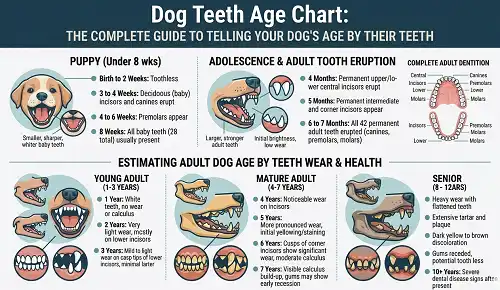
The Master Dog Teeth Age Chart
This chart covers your dog’s entire dental life — from bare newborn gums all the way to a 15-year-old senior’s worn-down molars. Use it as your first reference whenever you want to estimate a dog’s age by their teeth.
| Age Range | Teeth Present | Tooth Color | Tartar Level | Wear on Incisors | Gum Condition |
|---|---|---|---|---|---|
| 0 – 2 weeks | None — bare gums only | — | None | — | Soft, pink, healthy |
| 2 – 4 weeks | 1–12 teeth emerging (first incisors & canines) | Bright white | None | Tiny, needle-like tips | Pink, healthy |
| 4 – 8 weeks | All 28 baby teeth present | Brilliant white | None | Very sharp — no wear | Pink, firm |
| 3 – 5 months | Mix of baby and adult teeth; count varies | Mix — some brilliant white (adult), some slightly dull (baby) | None | Baby tips sharp; adult teeth just emerging | Slightly puffy near erupting teeth |
| 5 – 7 months | Adult teeth fully taking over; approaching 42 | Brilliant white | None | Fresh, crisp edges — three tiny cusps visible per incisor | Pink, firm, tight |
| 7 months – 1 year | All 42 permanent teeth present | Brilliant white, clean | None to minimal | Three incisor cusps still mostly intact | Pink, firm, no recession |
| 1 – 2 years | 42 permanent teeth | White to very slightly off-white | Very light — back teeth only | Cusps beginning to dull; tips slightly flattened | Pink; possibly mild redness near back tartar |
| 2 – 3 years | 42 permanent teeth | Off-white; yellowing begins | Light to moderate — premolars and molars | Cusps clearly worn; incisor tips noticeably flatter | Possible slight redness along gum line |
| 3 – 5 years | 42 or fewer if disease present | Yellow to tan | Moderate — visible brownish buildup on most back teeth | Cusps worn flat; incisor surface clearly rounded | Early gum recession; bad breath possible |
| 5 – 7 years | 42 or fewer | Yellow to brownish | Moderate to heavy | Incisors visibly shorter and flat; canine tips rounding | Noticeable recession; gums may bleed |
| 8 – 10 years | Often fewer than 42 | Dark yellow to brown | Heavy — widespread calculus | Teeth significantly shorter; heavy flattening | Clear recession; exposed roots; loose teeth possible |
| 10 – 15+ years | Significantly fewer — missing teeth common | Dark brown; possible dark spots or cracks | Very heavy — calculus may cover most of tooth surface | Severely worn; some incisors may be near the gum line | Significant recession; pain likely; broken teeth common |
Stage-by-Stage Breakdown: Birth to 15+ Years
The chart gives you the quick reference. This section gives you the detail — what exactly you will see at each stage, why it happens, and what it means for your dog’s age and health.
No Teeth — Bare Gums Only
Newborn puppies come into the world completely toothless. Their gums are soft, smooth, and pink. For their first two weeks, puppies rely entirely on their mother’s milk. There is nothing to bite with and nothing to chew — so no teeth are needed yet.
If you look inside a puppy’s mouth and see only bare pink gums with absolutely no tooth buds breaking through, that puppy is almost certainly under 2 weeks old.
- Teeth present: 0
- Key visual sign: Smooth bare gums, pink and soft
- Eyes: Usually still closed or barely open
- Movement: Crawling, not walking
Baby Teeth Coming In (Up to 28)
Starting around 2 to 3 weeks, the first baby teeth begin pushing through the gums. These tiny incisors at the front of the mouth are followed by the canine teeth (the little fangs) around 3 to 5 weeks. The premolars fill in last, between 4 and 8 weeks.
By 6 to 8 weeks — around the time most puppies move to their new homes — all 28 baby teeth should be in place.
| Tooth Type | Baby Teeth Appear At | Number |
|---|---|---|
| Incisors | 2–4 weeks | 12 |
| Canines | 3–5 weeks | 4 |
| Premolars | 4–8 weeks | 12 |
| Total | Full set by 6–8 weeks | 28 |
A puppy with fewer than 28 teeth and no adult teeth at all is almost certainly under 8 weeks old. This is an important detail for shelters determining whether a puppy is old enough to be adopted (most responsible shelters require at least 8 weeks).
Baby Teeth Out, Adult Teeth In
This is the most exciting — and most readable — window for age estimation. Between 3 and 7 months, puppies lose all 28 baby teeth and grow their complete set of 42 permanent adult teeth. The process happens in a predictable order:
| Tooth Type | Baby Teeth Fall Out | Adult Teeth Come In |
|---|---|---|
| Incisors (front teeth) | 3–4 months | 3–5 months |
| Canines (fangs) | 4–5 months | 5–6 months |
| Premolars (side teeth) | 4–6 months | 4–6 months |
| Molars (back teeth — new!) | No baby version existed | 4–7 months |
During this period your puppy may look “gap-toothed” as baby teeth fall out before adult teeth are fully grown. You might find tiny baby teeth on the floor or in their bedding — though many puppies simply swallow them. This is completely harmless.
A dog with a clear mix of small baby teeth and larger adult teeth is almost certainly between 3 and 6 months old. A dog with all adult teeth but crisp, fresh, unworked surfaces is likely 6 to 12 months old. This transition window is where teeth-based aging is at its most precise.
All 42 Teeth Present — White, Clean, and Sharp
By 7 months, your dog should have their full set of 42 permanent teeth. In a healthy young dog, these teeth are the picture of dental youth: brilliant white enamel, no tartar, crisp sharp edges on the canines, and three tiny distinct bumps (called cusps or fleur-de-lis) on the top edge of each incisor.
As the dog moves through 1 to 2 years of age, very subtle changes begin to appear. The tips of the incisor cusps start to flatten just slightly from normal use. You may find the very first trace of tartar beginning to accumulate on the back surface of the back molars.
- 7–12 months: Brilliant white, zero tartar, three sharp incisor cusps visible
- 1–2 years: Very slight dulling at incisor tips; possibly a faint yellow tinge on the gum-line edge of back teeth
- Gums: Bright pink, firm, tight to the tooth base
- Breath: Typically neutral or faintly “puppy-breath” — should not smell strongly unpleasant
Tartar Builds Up — Wear Becomes Visible
This is where the mouth starts telling a more detailed story. By 2 to 3 years, most dogs have noticeable tartar — a hard, yellowish-brown mineral deposit — building on the premolars and molars. The incisor tips show more obvious flattening. Canine teeth are still present and strong but the sharp edge is less pristine than it was at age one.
By 3 to 5 years, the changes become clear to anyone paying attention:
- Tartar visible as yellow-to-brown buildup on back teeth and near the gum line on front teeth
- Incisor tips clearly worn — no longer three distinct points, trending toward a flatter surface
- Canine tooth tips rounded compared to a young adult dog
- Color has shifted from white to off-white, cream, or light yellow
- Early gum redness where tartar meets the gum line
- Mild bad breath may begin due to bacteria in tartar deposits
Significant Wear, Heavy Tartar, Gum Changes
By 6 to 9 years, the dental changes are pronounced and easy to spot even for an untrained eye. Tartar is heavy across most teeth — it may appear as a thick brown coating on the premolars and molars, sometimes extending under the gum line where it is not visible without professional examination.
The incisors have been worn down noticeably. What were once three distinct cusps on each front tooth have been completely smoothed flat. Canine teeth are shorter and more rounded than in a young adult. Overall the teeth look smaller, flatter, and darker than they did five years ago.
Gum recession becomes visible at this stage. The gum line pulls away from the base of the tooth, exposing more of the root. Teeth that look “longer” than normal are almost always showing this recession — not actually growing. This is where the old phrase “long in the tooth” comes from, meaning an older animal or person.
Some dogs at this age begin to experience loose teeth, tooth root abscesses, or early-stage periodontal disease. Bad breath is common and is usually caused by the bacteria thriving in the tartar and under the receding gum line.
Missing Teeth, Severe Wear, Advanced Dental Disease
Senior dogs often show the most dramatic changes. By 10 years and beyond, it is common to see teeth that have been lost to advanced periodontal disease, fractured under years of stress, or extracted by a veterinarian at some point in the dog’s life. The remaining teeth are typically dark yellow to brown — sometimes nearly black at the base — heavily coated with calculus, and significantly shorter than they once were.
If you want to learn more about how to estimate the age of an older dog using all available physical signs — not just teeth — this detailed guide on how to find senior dog age walks through every indicator vets use for senior dogs.
Key Signs to Look for in Senior Dogs (10+ Years)
- Missing teeth — visible gaps where teeth have been lost or extracted
- Severely worn incisors — some may be worn almost to the gum line
- Dark yellow, brown, or black calculus coating much of the visible tooth surface
- Significant gum recession exposing the tooth root — sometimes more root visible than crown
- Fractured or cracked teeth, especially in dogs with a history of chewing hard objects
- Loose teeth that move when touched
- Signs of oral pain: reluctance to eat hard food, dropping food, chewing on one side, drooling, pawing at the face
Breed-Specific Differences in Dental Development
The master chart above works best for medium-sized dogs of average build. But breed size and jaw shape both influence dental development significantly — and ignoring breed type is one of the most common mistakes people make when estimating a dog’s age by their teeth.
Examples: Chihuahua, Yorkshire Terrier, Dachshund, Toy Poodle, Maltese, Pomeranian
Small dogs have the exact same number of teeth as large dogs (42 adult teeth) crammed into a much smaller jaw. This creates crowding, overlapping, and misalignment — all of which trap plaque and accelerate tartar buildup dramatically.
A small breed dog can show significant tartar and early gum disease by 2 to 3 years of age — an age where a medium-sized dog’s teeth might still look fairly clean. If you are using the age chart on a small breed dog, be aware that their teeth may look older than the chart suggests. Factor in a correction of roughly 1 to 2 years when looking at tartar levels.
Small breeds are also significantly more prone to retained baby teeth than larger dogs.
Examples: English Bulldog, French Bulldog, Pug, Boston Terrier, Shih Tzu, Boxer
Brachycephalic means “flat-faced” — these breeds have skulls that are compressed front-to-back, giving them their characteristic squashed nose appearance. The problem is that the jaw is shorter but the tooth count is the same 42 — leading to severely rotated, crowded, and misaligned teeth.
In flat-faced breeds, the standard eruption timeline can be irregular. Baby teeth may come in at unusual angles, and adult teeth may not emerge in the typical sequence. For these breeds specifically, a veterinary examination is far more reliable than visual self-assessment for age estimation.
Flat-faced breeds also tend to develop dental disease earlier and more severely than other breeds due to their jaw structure.
Examples: Great Dane, Saint Bernard, Irish Wolfhound, Mastiff, Newfoundland, German Shepherd
Large and giant breed dogs tend to follow the standard dental eruption timeline fairly accurately, though the process may proceed slightly more slowly compared to small breeds. Their adult teeth may take a few extra weeks to fully settle in the jaw.
Because their jaws are larger, large breeds tend to have less crowding and slightly slower tartar accumulation — meaning their teeth may look younger than a small breed dog of the same age. However, large breeds are prone to broken and fractured teeth due to their powerful bite force and tendency to chew aggressively. A fractured tooth in an otherwise youthful-looking mouth can confuse a teeth-based age estimate.
Giant breeds also have shorter lifespans, so their dental aging compresses — a 6-year-old Great Dane may show the dental wear of a 9-year-old medium breed dog.
Gum Health as an Age Indicator
Nearly every article about dog teeth age estimation focuses only on the teeth themselves — and misses the gums entirely. This is a significant gap, because the gums surrounding your dog’s teeth also change with age in predictable ways that provide valuable additional clues.
What Healthy Gums Look Like
In a young, healthy dog, the gums should be a vibrant bubble-gum pink (some breeds naturally have dark or spotted gums due to pigmentation — this is breed-normal and fine). More importantly, the gums should fit snugly and firmly against the base of each tooth, with no visible gap between the gum tissue and the tooth surface.
How Gums Change as a Dog Ages
| Age Range | Gum Appearance | What It Indicates |
|---|---|---|
| Under 1 year | Bright pink, firm, tight against all teeth | Healthy, young gums — no disease |
| 1 – 3 years | Still pink; mild redness may appear near heavy tartar deposits | Beginning of plaque and tartar irritation (gingivitis starting) |
| 3 – 6 years | Redness along gum line; earliest gum recession begins | Gingivitis; early periodontal disease possible |
| 6 – 9 years | Noticeable recession — teeth look “longer than before”; possible bleeding on contact | Active periodontal disease; bone loss may be occurring |
| 10+ years | Significant recession; exposed tooth roots visible; teeth may be loose | Advanced periodontal disease; pain likely |
The “Long in the Tooth” Sign Explained
You may have heard the expression “long in the tooth” used to describe an elderly person or animal. It comes directly from this phenomenon in horses and dogs. As a dog ages and gum disease progresses, the gum tissue slowly pulls back (recedes) away from the base of the tooth, exposing more of the tooth root below the surface. From the outside, the tooth appears to have gotten longer — but in reality, more root is simply being revealed as the gum retreats.
A tooth that looks noticeably longer than it did previously, or longer than the same tooth on a younger dog, is almost always showing gum recession — a clear sign of advancing age and dental disease.
Retained Baby Teeth: What They Are and Why They Matter for Age Estimation
A retained baby tooth is one that has stayed in place even after the permanent adult tooth it was supposed to be replaced by has already fully grown in. The result: two teeth occupying the same space where there should only be one.
Which Teeth Are Retained Most Often?
The canine teeth — the long fangs at the corners of the mouth — are retained most frequently. You will see the adult canine erupting while the baby canine is still firmly embedded beside it. Incisors can also be retained, though this is less common.
Which Breeds Are Most Prone to Retained Baby Teeth?
Retained baby teeth are far more common in small breeds, where the smaller jaw gives permanent teeth less room to push through properly. The most commonly affected breeds include:
- Chihuahua
- Yorkshire Terrier
- Maltese
- Pomeranian
- Toy and Miniature Poodle
- Shih Tzu
- Pekingese
Why Retained Teeth Affect Age Estimation
When two teeth are jammed into a space meant for one, the narrow gap between them becomes a trap for food particles, bacteria, and plaque. This leads to dramatically accelerated tartar buildup and early onset gum disease — making the dog’s teeth appear older than they actually are.
This is critical to keep in mind: a puppy or young dog with retained baby teeth may show heavy tartar and inflamed gums at just 1 to 2 years of age — not because the dog is old, but because the crowding has triggered abnormally rapid dental disease. If you see heavy tartar on a young-looking dog, always check for retained baby teeth before assuming the dog is older than they look.
What to Do About a Retained Baby Tooth
If you spot a baby tooth sitting directly alongside a fully emerged adult tooth — especially at 5 months or older — bring it to your veterinarian’s attention. Most vets recommend extracting retained baby teeth to prevent long-term crowding, tartar acceleration, and damage to the adult tooth root. This extraction is often done conveniently at the same time as the spay or neuter procedure.
How Accurate Is Teeth-Based Age Estimation, Really?
This is the question that every other article either skips or glosses over. The answer is: it depends heavily on the dog’s age.
Very Accurate — Puppies Under 7 Months
During the puppy and transition phases, teeth-based age estimation is remarkably precise — often accurate to within 2 to 4 weeks. The eruption sequence is consistent enough that an experienced shelter worker or veterinarian can look inside a puppy’s mouth and confidently say “this puppy is between 10 and 12 weeks old.” This is the method’s strongest window.
Fairly Reliable — 7 Months to 3 Years
After all adult teeth are in, accuracy decreases but remains useful. Estimates are typically within 6 to 12 months of the actual age. At this stage the vet is looking at early tartar levels and the beginning of incisor wear — clues that narrow the range without pinpointing an exact age.
Less Reliable — 3 Years and Older
For adult and senior dogs, teeth provide a broad age range rather than a precise estimate. A dog that has had excellent dental care — including regular professional cleanings and daily brushing — may have the teeth of a dog half their age. Conversely, a dog with no dental care, a soft-food diet, and small breed crowding may have the teeth of a dog twice their age. Estimates in this range can be off by 2 to 4 years in either direction.
Factors That Make Teeth Look Older Than the Dog Really Is
- Feeding only soft or wet food (less natural abrasion, faster plaque accumulation)
- Chewing inappropriate hard objects: rocks, metal cages, concrete (excessive mechanical wear)
- Small breed body type (crowding accelerates tartar)
- Brachycephalic jaw structure (abnormal alignment worsens disease)
- Retained baby teeth (crowding speeds up tartar and gum disease)
- No history of dental care or professional cleaning
- Nutritional deficiency or illness during development
Factors That Make Teeth Look Younger Than the Dog Really Is
- Regular professional dental cleanings
- Consistent daily tooth brushing at home
- Dental chews approved by the Veterinary Oral Health Council (VOHC)
- Eating dry kibble (provides mild natural abrasion)
- Genetics — some dogs are simply less prone to tartar and gum disease
- Larger jaw with good tooth spacing
Teeth vs. Other Age Estimation Methods
Veterinarians rarely rely on a single method when estimating a dog’s age. They combine dental findings with other physical signs to build a more complete picture. Here is how the different methods compare:
| Method | Best Age Range | Accuracy Level | Key Limitations |
|---|---|---|---|
| Teeth — eruption sequence | 0 to 7 months | Very high (within weeks) | Only works during the puppy phase |
| Teeth — wear and tartar | 1 to 10 years | Moderate (within 1–3 years) | Heavily affected by diet, care history, and breed |
| Coat graying | 5 years and older | Low to moderate | Highly variable; stress and genetics cause early graying in some dogs |
| Eye cloudiness | 7 years and older | Moderate | Must distinguish nuclear sclerosis (normal aging) from cataracts (disease) |
| Joint stiffness and movement | 7 years and older | Low | Injury or breed-related joint disease can mimic age-related changes |
| Skin elasticity | 7 years and older | Low | Nutrition and hydration levels skew results |
| Muscle mass and body condition | All ages | Low alone | Highly dependent on diet and exercise history |
| Bone density via X-ray | All ages | High | Requires veterinary radiograph — not a home method |
| DNA methylation test | All ages | Very high | Requires laboratory analysis; costs money; not yet widely available |
For the most reliable age estimate, veterinarians combine multiple methods — teeth, eyes, coat, joints, muscle mass, and skin — weighting each one based on the individual dog in front of them. If you want to see how all of these physical factors combine into a single estimate for your dog, a free online dog age calculator can help you factor in multiple indicators at once.
Step-by-Step Guide for Rescue Dog Owners
You just brought home a rescue dog with no paperwork. Here is exactly how to estimate their age by examining their teeth — even if you have never done this before. Take your time, use plenty of treats, and do not force the examination if your dog is uncomfortable.
Safety First
Only examine a calm, relaxed dog. If your dog is nervous, fearful, or reactive around the mouth, do not push it. Wait for a quiet moment when they are settled. Ask a second person to help by gently steadying the dog from behind. If your dog shows any sign of snapping or extreme stress, let your vet handle the examination at your first appointment — a stressed dog’s mouth tells you less anyway.
Count the Teeth
Gently lift the lips and count what you see. Even a rough count is very informative:
- No teeth at all: Almost certainly under 2 weeks old (neonatal)
- Fewer than 28 tiny, sharp teeth: Probably 2 to 7 weeks old (baby teeth still coming in)
- 28 small, needle-sharp teeth: Probably 6 to 10 weeks (full baby set present)
- Mix of small baby teeth and larger adult teeth: Almost certainly 3 to 6 months (transition phase)
- All large adult-generation teeth: Over 6 months old
- Fewer than 42 with no baby teeth visible: Middle-aged to senior (missing teeth from disease or extraction)
Check Tooth Color
Look at the front teeth first — they show color change most visibly:
- Brilliant, almost glowing white → Under 1 year
- White to very slightly off-white → 1 to 2 years
- Cream to light yellow → 2 to 4 years
- Yellow to yellow-brown → 4 to 7 years
- Dark yellow, brown, or near-black near gum line → 7 to 10+ years
Check for Tartar
Tartar (also called calculus) is a hard, crusty deposit — unlike soft plaque which is almost invisible. You can see and feel tartar: it is brownish or yellowish, firmly attached to the tooth surface, and most prominent near the gum line of the premolars and molars.
- No tartar anywhere → Under 1 year (usually)
- Light tartar on back teeth only → 1 to 3 years
- Moderate tartar on most back teeth → 3 to 6 years
- Heavy tartar with dark-colored buildup → 6 to 10 years
- Very heavy, widespread, covering most of visible tooth → 10+ years
Examine the Incisor Tips
The small front teeth — six on top and six on bottom — are your best wear-pattern indicators. In a young dog, each incisor has three tiny bumps at the tip, called a “fleur-de-lis” pattern or cusps. Watch how these change with age:
- Three distinct cusps clearly visible on most incisors → Under 1 year
- Cusps starting to blur and dull → 1 to 2 years
- Cusps mostly worn down; surface flattening → 2 to 4 years
- Incisor surfaces completely flat → 4 to 6 years
- Incisors visibly shorter overall → 7+ years
Check the Gums
Look at where the gum meets the base of the tooth. Pink, firm gums sitting tight to the tooth suggest a younger dog. Red, receding gums with the tooth root beginning to show suggest middle age or senior. Gums that bleed easily when touched are a sign of active periodontal disease, which is more common in older dogs.
Cross-Reference with Physical Signs
After your dental assessment, check these additional signs to confirm your estimate:
- Gray or white hair on muzzle, face, or around eyes → Usually 7+ years old
- Bluish or cloudy appearance in the eyes → Usually 8+ years (nuclear sclerosis or cataracts)
- Reluctance to jump; stiff movement getting up → Middle-aged to senior
- Skin that stays tented when gently pinched → Senior (reduced skin elasticity)
- Reduced muscle mass on the hindquarters → Older dog
Dental Care Plan by Age Stage
Estimating your dog’s age from their teeth is useful — but what you do with that information is what truly matters. Here is a practical dental care plan matched to each life stage, so you always know exactly what your dog needs right now.
| Age Stage | What You Should Do at Home | Professional Veterinary Care |
|---|---|---|
| 0 – 8 weeks Neonatal Puppy | Handle the mouth gently and often to build comfort. Let puppies chew age-appropriate soft toys. No brushing needed yet. | First vet visit — general check including jaw and gum development. Confirm tooth count on schedule. |
| 3 – 7 months Transition Phase | Introduce a soft finger brush or puppy toothbrush with dog-safe toothpaste. Check for retained baby teeth weekly. Provide appropriate chew toys — not hard bones at this age. | Alert vet to any retained baby teeth. Plan extraction if needed, ideally timed with spay or neuter surgery. |
| 7 months – 2 years Young Adult | Brush teeth daily if possible — at least three times per week. This is the best window to establish brushing as a lifelong routine. Introduce VOHC-approved dental chews. | First professional dental cleaning if any tartar is visible. Annual dental exam recommended. |
| 2 – 5 years Adult | Maintain daily brushing. Monitor for bad breath — it is an early disease warning. Combine brushing with dental chews and an appropriate kibble diet. | Professional cleaning every 1 to 2 years, more frequently for small breeds. Annual oral examination. |
| 6 – 9 years Mature Adult | Continue brushing. Watch for behavioral changes that suggest mouth pain: dropping food, favoring one side when chewing, reduced appetite for hard food, pawing at face. Consider adding dental water additives. | Annual professional dental exam with probing to check gum pocket depth. Dental X-rays may be recommended to assess tooth roots not visible to the naked eye. |
| 10+ years Senior | Gentle brushing if tolerated and cooperative. If brushing causes distress, focus on dental rinses and soft chews. Prioritize your dog’s overall comfort. Watch carefully for signs of dental pain affecting daily life. | Biannual dental exams. Pre-anesthetic blood panel required before any dental procedures under general anesthesia. Discuss pain management openly with your vet — dental pain in seniors is common and treatable. |
Not sure what age your dog is in human terms? Use a free dog age calculator to convert your dog’s estimated age into human years — factoring in their breed size for a more accurate result.
How many teeth does a dog have ?
Dogs have 28 teeth as puppies and 42 teeth as adults.
The baby teeth fall out around 3 to 7 months of age, just like children lose their milk teeth. The adult teeth that replace them are permanent — meaning your dog should keep those 42 teeth for the rest of their life with proper care.
How to tell age of dog by teeth ?
Here is what to look for when you open your dog’s mouth:
Tooth color Bright white → under 1 year. Yellowing → 2 to 5 years. Dark yellow or brown → 6 years and older.
Brown crusty buildup (tartar) No buildup at all → under 1 year. A little on the back teeth → 1 to 3 years. Heavy buildup everywhere → 5 years and older.
Worn front teeth The small front teeth on a young dog have three tiny bumps at the tip. As the dog ages those bumps wear flat. Bumps still sharp → young dog. Completely flat → older dog.
Mix of small and large teeth If you see tiny sharp baby teeth sitting alongside bigger adult teeth, the dog is almost certainly between 3 and 6 months old — still in the middle of teething.
Just keep in mind — this gives you a rough estimate, not an exact age. A dog with regular dental cleanings will have cleaner teeth than a neglected dog of the same age, which can throw off the guess by a year or two.