
Dog Life Cycle Explained: What Happens at Every Stage of Your Dog’s
Dogs are much more than pets — they are family. Whether you just brought home a tiny, wide-eyed puppy or you have a silver-muzzled senior by your side, understanding what your dog is going through at every stage of life will make you a better, more confident pet owner. This complete guide walks you through all six stages of a dog’s life — from the first breath to the golden years — with clear explanations, practical care advice, and science-backed insights that no one else is covering.
Why Understanding Your Dog’s Life Cycle Matters
Every dog goes through predictable stages of growth, development, and aging. Knowing which stage your dog is in right now helps you make the right decisions about their food, training, vet visits, exercise, and even their emotional needs.
A puppy needs very different care than a senior dog. An adolescent dog behaves very differently from a calm adult. When you understand the why behind your dog’s behavior and physical changes, you stop reacting in confusion and start responding with confidence.
The American Animal Hospital Association (AAHA) officially recognizes distinct life stages for dogs. Because dogs vary so much in size and breed, these stages do not happen at the exact same age for every dog. A Great Dane reaches senior status far earlier than a Chihuahua.
The 6 Stages of a Dog’s Life at a Glance
Most articles cover four basic life stages. This guide goes further, breaking the dog life cycle into six meaningful stages that reflect what is actually happening in your dog’s body and mind:
Now let us explore each stage in detail — what is happening in your dog’s body, what behaviors to expect, and exactly what they need from you.
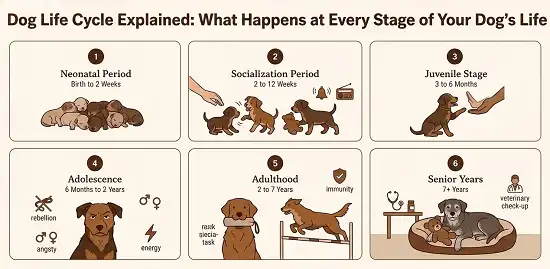
Neonatal Period: The First Two Weeks of Life
A newborn puppy comes into the world in a state of near-total helplessness. This first stage — called the neonatal period — lasts from birth until around two weeks of age, and it is one of the most critical and fragile periods in any dog’s life.
What Puppies Are Like at Birth
Newborn puppies are born with their eyes and ear canals completely closed, which means they are both blind and deaf. They have no teeth yet, and they cannot regulate their own body temperature. Even a small drop in warmth can be life-threatening for them at this stage.
Everything a neonatal puppy does revolves around two goals: staying warm and feeding. Their entire world at this age is their mother and their littermates. They move by crawling and paddling — instinctively pressing toward warmth and the scent of milk.
The Critical Role of the Mother
During the neonatal period, the mother dog does everything. She keeps the puppies warm, feeds them every two hours or so, stimulates their digestion by licking their bellies and hindquarters, and keeps them clean. Without their mother — or a dedicated human caregiver acting in her place — neonatal puppies cannot survive on their own.
The first milk a mother produces, called colostrum, is packed with antibodies that give the puppies their initial immune protection. Missing even a small amount of this first milk can make puppies vulnerable to infection in their early weeks.
What You Should and Should Not Do
✅ What You Should Do
- Keep the whelping area warm (around 85–90°F for the first week)
- Weigh puppies daily — steady weight gain means they are feeding well
- Handle puppies gently and briefly so they stay warm
- Watch for “fading puppy syndrome” — a sudden failure to thrive
- Contact your vet immediately if a puppy seems cold, weak, or is not feeding
❌ What You Should Avoid
- Do not separate puppies from their mother unnecessarily
- Do not allow loud noises or stress near the whelping area
- Do not let visitors handle neonates — germs can be deadly
- Do not expose puppies to drafts or cold surfaces
- Do not bathe puppies during this stage
- Maintain a warm, clean, and quiet whelping environment
- Ensure each puppy is nursing and gaining weight daily
- Watch the mother for signs of mastitis or postpartum illness
- Keep a record of birth weights and daily gains
- Schedule a vet check for mother and litter within 24–48 hours of birth
Socialization Period: 2 to 12 Weeks
Around two weeks of age, something remarkable happens. Puppies begin to open their eyes. Their ears unseal and they hear sound for the first time. The world suddenly comes alive for them, and they begin to explore it with curiosity and wonder.
This period — from about two weeks to twelve weeks — is called the socialization period, and it is arguably the most important developmental window in a dog’s entire life.
The Critical Socialization Window: Why 3 to 12 Weeks Is Everything
Between the ages of three weeks and three months, puppies are in what scientists call a “sensitive period” for socialization. During this window, a puppy’s brain is wide open to learning what is normal, safe, and familiar in the world. Whatever they are positively exposed to during this time — different people, other animals, sounds, surfaces, and environments — they are far more likely to accept calmly for the rest of their lives.
First Puppy Teeth Begin to Appear
At around three to four weeks of age, something else exciting happens — the very first teeth begin to push through the gums. These early teeth are called deciduous teeth, or more commonly, “milk teeth” or “baby teeth.” They are tiny, razor-sharp, and temporary. By the time a puppy is around six weeks old, a full set of 28 baby teeth will have erupted.
As soon as those little teeth appear, puppies start practicing biting on each other. This play-biting teaches them a crucial skill called bite inhibition — the ability to control the force of their bite. This is why keeping puppies with their littermates and mother until at least eight weeks of age is so important.
Vaccination Schedule Begins Here
The socialization period is also when your puppy’s vaccination journey begins. The immunity puppies receive from their mother’s colostrum starts to wear off, and your veterinarian will begin the core vaccination series around six to eight weeks of age.
Most veterinary organizations recommend starting puppy socialization classes as early as seven to eight weeks, as long as the puppy has had at least one round of vaccinations at least seven days before class. The benefits of early socialization outweigh the small health risk of waiting.
What Happens When Socialization Is Missed
When a puppy does not receive positive exposure to the world during the three-to-twelve-week window, they often develop lasting fears. A dog that has never heard a vacuum cleaner, seen a man with a beard, or walked on a wood floor during this period may react with panic or aggression to these things as an adult. Many of the dogs surrendered to shelters for “behavioral problems” simply missed a proper socialization window.
- Begin first vaccination series at 6–8 weeks with your veterinarian
- Introduce puppy to different people — different ages, genders, appearances
- Expose to everyday sounds: traffic, music, appliances, children
- Let puppy walk on different surfaces (grass, tile, carpet, gravel)
- Start basic puppy training — sit, name recognition, come
- Enroll in a puppy socialization class after first vaccination
- Teach bite inhibition through supervised play
- Begin microchipping at 8 weeks
- Do not separate from mother and littermates before 8 weeks
Juvenile Stage: 3 to 6 Months — The Teething Phase
By three months of age, most puppies have gone to their forever homes and are beginning to settle in with their new families. They are energetic, curious, and absolutely adorable — but they are also entering one of the chewiest periods of their lives: teething.
Puppy Teething — When It Starts and What to Expect
Puppy teething begins at around three to four months of age and continues until about six to seven months, when all of the adult teeth have grown in. During this period, your puppy’s 28 baby teeth fall out one by one, and 42 permanent adult teeth grow in to replace them.
Teething is uncomfortable. The growing teeth push against sensitive gum tissue, causing soreness, itching, and sometimes mild swelling. This is why your puppy chews on everything in sight — it relieves the pressure and discomfort in their gums. Chewing is not bad behavior; it is a completely natural and necessary response to what is happening in their mouth.
Complete Puppy Teeth vs. Adult Teeth Timeline
| Age of Puppy | What Is Happening with Teeth | Number of Teeth |
|---|---|---|
| Birth to 2 weeks | No teeth present — gums are toothless at birth | 0 |
| 3 to 4 weeks | First baby (deciduous) teeth begin to erupt — incisors appear first | Up to 12 |
| 4 to 6 weeks | Canine teeth and premolars erupt — full set of baby teeth complete | 28 (complete) |
| 3 to 4 months | Baby incisors begin to fall out; adult incisors begin growing in | Mixed — losing and gaining |
| 4 to 5 months | Adult canine teeth erupt; premolars start replacing baby premolars | Mixed — active teething |
| 5 to 6 months | Adult molars grow in (molars are permanent, no baby molar equivalent) | Nearing 42 |
| 6 to 7 months | All 42 adult teeth fully erupted — teething complete | 42 (complete) |
Note: Timing varies slightly by breed and individual dog. Large breeds may complete teething slightly earlier than small breeds.
Signs Your Puppy Is Teething
- Chewing everything: Shoes, furniture, wires, toys — nothing is off-limits
- Drooling more than usual: Extra saliva is common during active teething
- Finding tiny teeth on the floor: Baby teeth fall out and are often swallowed — this is normal
- Sore or slightly swollen gums: Red, tender gums are a normal part of teething
- Reduced appetite briefly: Sore gums can make eating uncomfortable for a short time
- Increased whining or restlessness: Discomfort can make a puppy fussier than usual
How to Manage Teething Behavior
The key to surviving the teething phase is redirection, not punishment. Your puppy is not chewing your furniture because they are naughty — they are chewing because their gums hurt and they need relief.
- Offer plenty of safe, appropriate chew toys — rubber chews, rope toys, nylon bones
- Freeze a damp washcloth and give it to your puppy — cold soothes sore gums
- Try frozen dog treats or frozen carrots for natural gum relief
- Puppy-proof your home — store shoes, wires, and valuables out of reach
- Whenever your puppy chews something they should not, calmly redirect them to a toy
- Supervise closely — unsupervised puppies find the most valuable things to destroy
Nutrition for Growing Puppies
During the juvenile stage, your puppy’s body is growing at an extraordinary rate. Their nutritional needs are very different from an adult dog’s. Puppies need food that is specifically formulated for growth — higher in protein, calcium, and calories per pound of body weight than adult dog food.
Look for a label that says “formulated for puppies” or “all life stages.” Feed three meals per day for puppies under four months, then transition to two meals per day from four to six months. Always follow the feeding guide on the package and adjust based on your puppy’s growth and energy level.
- Provide safe, appropriate chew toys to manage teething discomfort
- Puppy-proof your home — expect chewing behavior to peak at 4–5 months
- Continue vaccination series (typically 12-week and 16-week boosters)
- Discuss spay/neuter timing with your veterinarian
- Feed a high-quality puppy formula food, three times daily
- Begin basic obedience training — sit, stay, leave it, come
- Schedule a vet dental check — ensure no retained baby teeth at 6 months
- Continue socialization — new environments, people, and animals
Adolescence: 6 Months to 2 Years — The Teenage Dog
If there is one stage of the dog life cycle that catches most owners completely off guard, it is adolescence. Your sweet, manageable puppy seems to overnight transform into a creature that ignores commands they definitely knew, chews things they had long stopped touching, and looks at you with a kind of selective hearing that is almost impressive.
This is the dog version of the teenage years — and it is real, it is driven by biology, and it is temporary.
When Does Adolescence Start? A Breed-Size Breakdown
Adolescence does not begin at the same age for every dog. Smaller breeds tend to hit this stage earlier, while large and giant breeds move through it more slowly:
| Breed Size | Weight Range | Adolescence Begins | Adolescence Ends |
|---|---|---|---|
| Toy & Small breeds | Under 20 lbs | 6–8 months | 12–14 months |
| Medium breeds | 20–50 lbs | 6–9 months | 14–18 months |
| Large breeds | 50–100 lbs | 9–12 months | 18–24 months |
| Giant breeds | 100+ lbs | 12–15 months | 24–36 months |
Physical Changes During Adolescence
During adolescence, a dog’s explosive puppy growth slows down, and the body begins to fill out and become more muscular. Smaller breeds may reach their full size by around one year of age, while large and giant breeds continue growing in height and weight until age two or even three.
At this stage, a dog’s puppy coat sheds and is replaced by their adult coat. You may notice significant shedding during this transition. Hormones begin surging through the body, triggering sexual maturity — and all the behavioral changes that come with it.
Why Adolescence Is the Most Challenging Stage for Owners
Adolescence is the single most common reason dogs are surrendered to shelters. Owners who were patient and loving with a puppy find the adolescent stage overwhelming when their dog suddenly seems to forget everything they were taught. This is not stubbornness or spite — it is neurology.
The adolescent dog’s brain is undergoing a massive reorganization. The prefrontal cortex — the part of the brain that controls impulse control and decision-making — is not fully developed yet. Combined with a flood of sex hormones, this creates a dog that genuinely struggles to make the “right” choice, even when they know what it is.
Sexual Maturity and Spay/Neuter Timing
Female dogs typically experience their first heat cycle between six and eighteen months of age, though this varies widely by breed. Male dogs reach sexual maturity at a similar time and may begin marking territory, roaming, and showing interest in females.
The ideal timing for spaying or neutering is something to discuss directly with your veterinarian. The traditional recommendation was to spay or neuter before the first heat, around six months. However, more recent research — particularly for larger breeds — suggests that waiting until the dog reaches physical maturity may be beneficial for joint health and hormone development. Your vet will give you a recommendation tailored to your dog’s specific breed, size, and health status.
- Continue obedience training consistently — short, positive sessions daily
- Provide at least 60–90 minutes of physical exercise per day for medium/large breeds
- Add mental enrichment — puzzle feeders, nose work, agility, training games
- Do not punish regression in training — patience and consistency are key
- Discuss spay/neuter timing with your vet based on breed and size
- Watch for heat cycles in unspayed females — every 6 months on average
- Secure fencing and leash safety — adolescent dogs are prone to bolting
- Annual wellness exam including dental check and parasite prevention
Adulthood: The Prime Years (2 to 7 Years)
The arrival of adulthood feels like a gift to most dog owners. Around two years of age — sometimes a little later for large and giant breeds — your dog settles into their full, adult self. The frantic energy of puppyhood and the chaos of adolescence give way to a companion who is confident, predictable, and deeply connected to their family.
When Is a Dog Fully Grown?
Full physical maturity depends on breed size. Small dogs are physically mature by about one year. Medium dogs by twelve to eighteen months. Large breeds by eighteen to twenty-four months, and giant breeds may not be fully mature until they are two to three years old.
Emotional and behavioral maturity typically follows a few months behind physical maturity. A two-year-old Labrador may be physically full-grown but still act like a puppy in terms of energy and impulse control — this is completely normal.
What the Prime Years Look Like
Adult dogs in their prime years — generally from age two to seven — are at their physical and mental peak. They have the energy and health to enjoy exercise, play, training, and adventure, but also the maturity to settle down and relax. For most families, this is their favorite phase of dog ownership.
🏃 Physical Peak
- Full strength and stamina for activity
- Strong immune system with proper vaccination
- Healthy weight maintenance (with proper diet)
- Coat in best condition of their life
- Excellent dental health (if cared for)
🧠 Mental Peak
- Full impulse control and decision-making
- Strong bond and communication with owner
- Ability to learn complex commands and behaviors
- Consistent, predictable personality
- Excellent candidate for advanced training
Health Maintenance During the Prime Years
Just because your adult dog looks and feels great does not mean they can skip veterinary care. Annual wellness exams are essential for catching health issues before they become serious. During the prime years, your vet will typically check for heartworm, perform parasite prevention, update booster vaccinations, and conduct a thorough physical exam including dental assessment.
Dental disease is the most common health condition in adult dogs — by age three, most dogs show early signs of periodontal disease. Regular tooth brushing at home (daily if possible) and professional dental cleanings as recommended by your vet make a significant difference in your dog’s long-term health.
Nutrition in the Prime Years
Adult dogs require a balanced diet formulated specifically for maintenance — not growth, as puppies need. Look for foods that list a high-quality protein (chicken, beef, salmon, lamb) as the first ingredient. Avoid foods with excessive fillers like corn syrup, artificial colors, or unnamed meat by-products.
Most adult dogs do well on two meals per day. Overfeeding is the single most preventable health risk for adult dogs — obesity shortens a dog’s lifespan by up to two years and increases the risk of joint disease, diabetes, and heart conditions.
- Annual wellness veterinary exam — including heartworm test and dental assessment
- Maintain year-round flea, tick, and heartworm prevention
- Brush teeth at least 2–3 times per week; schedule dental cleanings as advised
- Feed a high-quality adult dog food — two meals per day
- 30–60 minutes of exercise per day (varies by breed and energy level)
- Continue mental enrichment — training, puzzle toys, new experiences
- Monitor weight — adjust food if your dog starts gaining or losing unexpectedly
- Watch for early signs of health changes: increased thirst, limping, behavioral shifts
Senior and Geriatric Years: 7+ Years — The Golden Age
There is something deeply special about a senior dog. They have grown into themselves. They know you. They know what they love. And while their pace may have slowed, their capacity for love has only deepened. The senior years deserve your best attention and care — because with the right support, many dogs thrive well into their teens.
When Is a Dog Considered a Senior?
There is no single age at which all dogs become seniors. Breed size plays the largest role. In general, small dogs enter their senior years later, while giant breeds are considered seniors surprisingly early in their lives:
Want a more precise answer for your specific dog? Use this how to find senior dog age guide for a detailed breakdown based on your dog’s breed and weight.
Physical Signs of Aging in Dogs
Aging in dogs is gradual, but once you know what to look for, the signs become clear. Here are the most common physical changes you will see in a senior dog:
- Grey or white muzzle: Greying around the face and muzzle is one of the earliest and most visible signs of aging in dogs
- Reduced energy and stamina: Senior dogs tire more easily and need more rest throughout the day
- Stiffness after rest: Arthritis is extremely common in senior dogs — you may notice your dog moving slowly after sleeping
- Weight changes: Some seniors gain weight as metabolism slows; others lose weight due to muscle loss or illness
- Changes in vision and hearing: Cloudy eyes (nuclear sclerosis or cataracts) and reduced hearing sensitivity are common
- Dental deterioration: Tartar buildup, gum disease, and tooth loss increase significantly with age
- Changes in coat quality: The coat may become thinner, coarser, or develop dry skin
- Increased thirst and urination: Can signal kidney disease, diabetes, or Cushing’s disease — always worth reporting to your vet
Canine Cognitive Dysfunction — When Aging Affects the Brain
One of the most important senior dog topics that almost no pet owner resource covers properly is Canine Cognitive Dysfunction (CCD) — the dog equivalent of dementia or Alzheimer’s disease.
CCD affects a significant number of dogs over the age of eleven, and its signs are often mistaken for “just getting old.” Recognizing the signs early means you can work with your veterinarian to slow its progression and keep your dog comfortable and connected.
Veterinarians use the acronym DISHA to describe the five main signs of CCD:
| Letter | Sign | What It Looks Like |
|---|---|---|
| D | Disorientation | Getting lost in familiar rooms, staring at walls, walking into corners |
| I | Interaction changes | Less interest in family members, reduced social engagement |
| S | Sleep-wake changes | Sleeping during the day, pacing or restless at night |
| H | House soiling | Accidents indoors in a previously housetrained dog |
| A | Activity changes | Decreased interest in play, increased anxiety, new fears |
If you notice any of these DISHA signs, speak with your veterinarian promptly. Several treatments can help, including specialized senior diets rich in omega-3 fatty acids and antioxidants, supplements like SAMe or medium-chain triglycerides (MCTs), environmental enrichment strategies, and in some cases, medications.
Senior Nutrition: What Changes and Why
Senior dogs often need a diet adjustment. As metabolism slows and activity levels decrease, many seniors need fewer calories to avoid weight gain. At the same time, older dogs benefit from higher-quality, more digestible protein to maintain muscle mass as they naturally lose muscle tone with age.
Some seniors benefit from foods specifically formulated for older dogs, which may contain joint-supporting ingredients like glucosamine and chondroitin, added omega-3 fatty acids for brain and joint health, and adjusted phosphorus levels to support kidney function. Ask your veterinarian whether a senior-formula food is right for your dog.
Home Modifications That Help Senior Dogs Thrive
Making a few simple changes to your home can dramatically improve your senior dog’s quality of life and comfort:
- Orthopedic dog bed: Thick, memory foam beds reduce joint pressure and make getting up and lying down much easier
- Non-slip mats and rugs: Hardwood and tile floors are slippery for arthritic dogs — rubber-backed rugs provide traction and prevent painful falls
- Ramps or dog stairs: If your dog loves sleeping on the bed or sofa, a gentle ramp removes the stress and pain of jumping
- Raised food and water bowls: Eating from floor level is uncomfortable for dogs with neck or shoulder arthritis — raised bowls reduce strain
- Warmth: Senior dogs feel cold more easily — a warm sleeping spot away from drafts makes a real difference
- Nightlights: For dogs with declining vision, soft nightlights in hallways and sleeping areas reduce nighttime disorientation
End-of-Life Care and Quality of Life Assessment
No guide to the dog life cycle would be complete without acknowledging its final chapter with honesty and compassion. Every pet owner faces the hardest part of dog ownership — knowing when their beloved companion is suffering and when it may be time to let them go.
Veterinarians often use a Quality of Life scale to help owners make this deeply personal decision. One of the most widely used is the HHHHHMM Scale, which evaluates seven areas:
| Letter | Area | Question to Ask |
|---|---|---|
| H | Hurt | Is pain being managed? Can the dog breathe comfortably? |
| H | Hunger | Is the dog eating enough to maintain body weight? |
| H | Hydration | Is the dog getting enough fluids and staying hydrated? |
| H | Hygiene | Can the dog be kept clean and free from sores and infections? |
| H | Happiness | Does the dog show interest in life — family, activities, or favorite things? |
| M | Mobility | Can the dog move around enough to experience some quality of life? |
| M | More good days than bad | When you look at the week overall, do good days outnumber difficult ones? |
This scale is not a verdict — it is a conversation starter. Your veterinarian, combined with your intimate knowledge of your dog, will guide you through this process with care and compassion. Palliative care and hospice options are also available for dogs in their final months and deserve consideration as a way to maintain dignity and comfort.
- Vet visits every 6 months (not just annually) for senior dogs
- Routine blood panels to monitor kidney, liver, and thyroid function
- Dental cleanings under anesthesia as advised — dental disease worsens rapidly in seniors
- Switch to a senior-appropriate diet after consulting your vet
- Maintain gentle, moderate daily exercise — walks, swimming, and gentle play
- Monitor for DISHA signs — report to vet promptly if noticed
- Make home modifications: orthopedic bed, non-slip rugs, ramps, raised bowls
- Keep your senior dog socially engaged — mental stimulation slows cognitive decline
- Discuss the HHHHHMM quality of life scale with your vet if health declines
How Breed Size Affects Your Dog’s Entire Life Cycle
One of the most important things to understand about the dog life cycle is that not all dogs age the same way. A Chihuahua and a Great Dane are both dogs, but they age so differently that comparing their life stages without accounting for size is like comparing apples to oranges.
Why Do Large Dogs Age Faster?
Scientists believe that larger dogs age faster primarily because their bodies grow at a dramatically faster rate early in life. All that rapid growth puts intense stress on the heart, joints, and organs. Faster cell replication — needed to build a large body quickly — also leads to earlier cellular aging. Large and giant breed dogs essentially “burn faster” physiologically, which is why they have shorter lifespans despite often living just as healthy a life as small breeds.
Life Stage Timeline by Breed Size
| Life Stage | Toy/Small (<20 lbs) | Medium (20–50 lbs) | Large (50–100 lbs) | Giant (100+ lbs) |
|---|---|---|---|---|
| Puppyhood ends | ~7–9 months | ~9–12 months | ~12–15 months | ~15–24 months |
| Adolescence | 6 mos – 1.5 yrs | 6 mos – 2 yrs | 9 mos – 2.5 yrs | 12 mos – 3 yrs |
| Full adult size | ~1 year | ~1.5 years | ~2 years | ~2–3 years |
| Senior stage begins | ~10–11 years | ~8–9 years | ~7–8 years | ~5–6 years |
| Average lifespan | 14–16 years | 12–14 years | 10–13 years | 8–10 years |
Note: These are general averages. Individual dogs may vary based on breed, genetics, nutrition, and veterinary care.
A seven-year-old Golden Retriever (a large breed) is already in their senior years and would benefit from twice-yearly vet visits and a senior-formula diet. A seven-year-old Miniature Poodle (a small breed) is still in their prime adult years and likely has another six or more healthy years ahead of them.
Dog Teeth Development — The Complete Guide
A dog’s teeth are one of the most revealing windows into their age, health, and life stage. Yet this is one of the most overlooked topics in dog ownership. Whether you are trying to figure out the age of a rescue dog, track your puppy’s teething progress, or maintain your adult dog’s dental health, understanding how your dog’s teeth develop is genuinely valuable knowledge.
Puppy Teeth: The Deciduous (Baby Tooth) Set
Puppies are born toothless. Their first teeth — called deciduous teeth, or baby teeth — begin to emerge at around three to four weeks of age. By six weeks, a full set of 28 deciduous teeth is in place. These baby teeth are smaller, thinner, and sharper than adult teeth, which is why puppy bites feel like tiny needles.
The 28 baby teeth are distributed as follows:
- 12 incisors (6 on top, 6 on bottom) — the small front teeth used for nibbling
- 4 canine teeth (2 on top, 2 on bottom) — the long, pointed “fang” teeth
- 12 premolars (6 on top, 6 on bottom) — the cheek teeth behind the canines
- 0 molars — puppies have no baby molars; these are adult teeth only
Adult Teeth: The Permanent Set
Starting at around three to four months of age, the baby teeth begin to fall out and are replaced by 42 permanent adult teeth. This is a larger, stronger, and more complete set designed to last the rest of your dog’s life.
The 42 adult teeth break down as follows:
- 12 incisors (6 top, 6 bottom)
- 4 canines (2 top, 2 bottom)
- 16 premolars (8 top, 8 bottom)
- 10 molars (4 top, 6 bottom) — these are brand new; there are no baby molar equivalents
Occasionally, a baby tooth does not fall out when the adult tooth grows in behind it. This is called a retained deciduous tooth, and it is most common in small and toy breeds. It can cause crowding, misalignment, and increased plaque buildup. If you notice a puppy tooth still present alongside an adult tooth at six months of age, mention it to your veterinarian — extraction is simple and prevents long-term dental problems.
How to Read Your Dog’s Teeth Like a Vet — Age Estimation Chart
If you have ever adopted a rescue dog without knowing their age, or you are simply curious how old an unknown dog might be, a dog’s teeth are one of the most reliable physical indicators available. Vets, shelter workers, and rescue organizations use tooth condition to estimate age with a reasonable degree of accuracy.
For a comprehensive visual reference, explore this detailed dog-teeth-chart that shows exactly what to look for at each age.
| Estimated Age | Tooth Condition | What to Look For |
|---|---|---|
| Under 8 weeks | All baby (deciduous) teeth | Tiny, needle-sharp baby teeth; all 28 present if over 6 weeks |
| 3–7 months | Mixed — teeth transitioning | Baby teeth falling out; adult teeth erupting; may see both present at once |
| Under 1 year | All adult teeth present | 42 adult teeth fully in; bright white, no wear or discoloration |
| 1–2 years | Clean adult teeth with very slight wear | Teeth still white; very minor wear on the tips of the back molars |
| 3–5 years | Moderate tartar, beginning yellowing | Yellowish discoloration; visible tartar on back teeth; gum line may show early inflammation |
| 5–10 years | Heavy tartar, significant wear | Brown tartar buildup; obvious tooth wear; possible gum recession; may show tooth loss |
| 10+ years | Severe tartar, wear, or tooth loss | Multiple missing or broken teeth; heavy calculus deposits; gum disease likely present |
Important: Tooth condition varies significantly based on dental care, diet, and genetics. A dog whose teeth have been brushed regularly throughout their life may show far less wear than this chart suggests for their age.
Dog Years vs. Human Years — The Real Calculation
“One dog year equals seven human years.”
This widely repeated rule is a dramatic oversimplification. A one-year-old dog is not equivalent to a seven-year-old child — they are more like a fifteen-year-old human, already sexually mature and capable of reproduction. The math simply does not hold up, particularly in the early years when dogs age rapidly and in the later years when the rate of aging slows.
The truth is that dogs age at very different rates during different stages of their lives — and this rate is heavily influenced by their size. A more accurate way to think about dog years is to use size-adjusted calculations like the ones in this dog age calculator, which gives you a personalized human-age equivalent based on your dog’s actual weight and breed size.
Dog Years to Human Years — Size-Based Comparison
| Dog’s Age | Small (<20 lbs) | Medium (20–50 lbs) | Large (50–100 lbs) | Giant (100+ lbs) |
|---|---|---|---|---|
| 6 months | ~7 yrs | ~7 yrs | ~6 yrs | ~6 yrs |
| 1 year | ~15 yrs | ~15 yrs | ~15 yrs | ~12 yrs |
| 2 years | ~24 yrs | ~24 yrs | ~24 yrs | ~22 yrs |
| 4 years | ~32 yrs | ~32 yrs | ~32 yrs | ~38 yrs |
| 6 years | ~40 yrs | ~42 yrs | ~45 yrs | ~49 yrs |
| 8 years | ~48 yrs | ~51 yrs | ~55 yrs | ~64 yrs |
| 10 years | ~56 yrs | ~60 yrs | ~66 yrs | ~79 yrs |
| 12 years | ~64 yrs | ~69 yrs | ~77 yrs | ~93 yrs |
| 14 years | ~72 yrs | ~78 yrs | ~88 yrs | ~107 yrs |
| 16 years | ~80 yrs | ~87 yrs | ~99 yrs | — |
Approximate human-age equivalents. Based on size-adjusted aging models used by veterinary researchers. Giant breed columns end where average lifespan typically does.
Notice how dramatically the numbers diverge for giant breeds. A ten-year-old Great Dane, at approximately 79 human years, is genuinely elderly — their body has aged the equivalent of nearly eight decades of human life. Meanwhile, a ten-year-old Yorkshire Terrier at about 56 human years is more like a healthy middle-aged adult. This is why the same care approach cannot be applied to all dogs.
Complete Dog Life Stage Summary — Quick Reference Table
Use this master reference table to quickly understand what your dog needs at every stage of their life:
| Life Stage | Age Range | Key Physical Events | Dental Stage | Vet Visit Frequency | Top Priority |
|---|---|---|---|---|---|
| Neonatal | Birth–2 weeks | Eyes/ears closed; no teeth; cannot thermoregulate | No teeth | Within 24–48 hrs of birth | Warmth, nursing, mother’s care |
| Socialization | 2–12 weeks | Eyes/ears open; 28 baby teeth erupt; rapid brain development | Baby teeth complete by 6 wks | 6, 8, and 12 weeks | Socialization & vaccination start |
| Juvenile | 3–6 months | Teething; rapid body growth; baby teeth falling out | Active teething 3–7 months | 12 and 16 weeks boosters | Teething management & training |
| Adolescence | 6 mos–2 yrs* | Sexual maturity; hormonal surge; growth slowing | 42 adult teeth complete by 7 mos | Annual wellness exam | Consistent training & enrichment |
| Adulthood | 2–7 years* | Full physical and emotional maturity; peak health | White teeth; watch for tartar at 3–5 yrs | Annual wellness exam | Dental care, weight, prevention |
| Senior/Geriatric | 7+ years* | Slowing metabolism; arthritis; possible CCD; cognitive changes | Heavy tartar; wear; possible tooth loss | Every 6 months | Comfort, diagnostics & quality of life |
*Age ranges marked with an asterisk vary based on breed size. Large and giant breeds age faster; small and toy breeds age more slowly. Always consult your veterinarian for your specific dog’s life stage assessment.
📋 Disclaimer
This article is intended for general educational and informational purposes only. The content provided here is not a substitute for professional veterinary advice, diagnosis, or treatment. Every dog is a unique individual, and life stage timelines, health recommendations, and care needs can vary significantly based on breed, genetics, individual health status, and other factors. Always consult a licensed, qualified veterinarian before making any decisions regarding your dog’s health, diet, vaccination schedule, reproductive care, or medical treatment. The life stage information in this article is based on widely accepted veterinary guidelines, including the AAHA Canine Life Stage Guidelines, and is designed to help you have more informed conversations with your veterinary care team — not to replace those conversations. The internal links provided in this article point to educational resources and tools intended to supplement, not replace, veterinary guidance.