
Dog Lifespan by Breed
When you bring a dog home, one of the most natural questions you’ll ask is: how long will this breed actually live? Not a rough average across all dogs — but your specific breed, with its specific health history and genetic background. This guide answers exactly that. Below you’ll find a comprehensive breed-by-breed lifespan chart covering over 100 breeds, the primary causes of death for the most popular breeds, real record-holding dogs, and the breeds that break all the expected rules.
This article focuses entirely on breed-specific lifespan data — the one question most dog guides don’t answer in enough detail. If you’d like to understand the broader science of why dogs age differently by size, or how to calculate your dog’s age in human years, the DogAgeHub dog age calculator covers those topics in depth.
What “Average Lifespan” Actually Means for a Breed
Before diving into the numbers, it’s worth understanding something that almost every competitor article skips: breed lifespan figures come from several different large-scale studies, and they don’t always agree — because they measured different dogs in different countries under different conditions.
Dogs seen at UK vets. Overall average: 11.2 years. Reports slightly lower numbers — includes dogs that died young from illness or accidents.
Dogs seen at US veterinary hospitals. Reports a higher mean of 12.69 years — reflects a generally well-cared-for clinical population.
UK dogs across 155 breeds. The most breed-specific dataset available — the source most articles cite for individual breed numbers.
This is why you’ll see “French Bulldog lifespan: 10–12 years” on one site and “4.53 years” on another — they’re measuring different things. In the chart below, ranges represent what healthy, well-cared-for individuals of each breed typically achieve.
Complete Dog Lifespan by Breed Chart (A–Z)
This table covers over 100 breeds with their typical lifespan, size group, and the most common health concern affecting longevity in that specific breed. Scroll right on mobile to see all columns. Sticky headers stay visible as you scroll down.
| Breed | Size | Typical Lifespan | Primary Longevity Risk |
|---|---|---|---|
| Affenpinscher | Small | 12–15 yrs | Heart disease, respiratory issues |
| Afghan Hound | Large | 12–14 yrs | Cancer, bloat (GDV) |
| Airedale Terrier | Medium | 11–14 yrs | Cancer, hip dysplasia |
| Akita | Large | 10–13 yrs | Autoimmune disease, cancer |
| Alaskan Malamute | Large | 10–14 yrs | Bloat, hip dysplasia, cancer |
| Australian Cattle Dog | Medium | 12–16 yrs | Progressive retinal atrophy, deafness |
| Australian Shepherd | Medium | 13–15 yrs | Cancer, epilepsy, hip dysplasia |
| Basenji | Medium | 13–14 yrs | Fanconi syndrome (kidney disorder) |
| Basset Hound | Medium | 12–13 yrs | Back problems (IVDD), obesity |
| Beagle | Medium | 12–15 yrs | Cancer, epilepsy, obesity |
| Bedlington Terrier | Small | 13–16 yrs | Copper toxicosis (liver), kidney disease |
| Belgian Malinois | Large | 14–16 yrs | Hip dysplasia, elbow dysplasia |
| Bernese Mountain Dog | Giant | 6–8 yrs | Cancer (histiocytic sarcoma) — highest cancer rate of any breed |
| Bichon Frise | Small | 14–15 yrs | Bladder stones, dental disease |
| Bloodhound | Large | 10–12 yrs | Bloat, heart disease, ear infections |
| Border Collie | Medium | 12–15 yrs | Epilepsy, Collie Eye Anomaly, cancer |
| Border Terrier | Small | 13–16 yrs | Heart disease, Spike’s disease (late onset) |
| Boston Terrier | Small | 11–13 yrs | Respiratory issues (brachycephalic), cataracts |
| Boxer | Large | 10–12 yrs | Cancer, heart disease (cardiomyopathy) |
| Brittany Spaniel | Medium | 12–14 yrs | Hip dysplasia, epilepsy |
| Brussels Griffon | Small | 12–15 yrs | Respiratory issues, eye problems |
| Bulldog (English) | Medium | 8–10 yrs | Respiratory disease, joint problems, heat intolerance |
| Bullmastiff | Giant | 7–9 yrs | Cancer, bloat, heart disease |
| Cairn Terrier | Small | 13–15 yrs | Liver shunt, skin disease |
| Cane Corso | Giant | 9–12 yrs | Hip dysplasia, bloat, heart disease |
| Cavalier King Charles Spaniel | Small | 9–14 yrs | Mitral valve heart disease — affects almost all by age 5–6 |
| Chihuahua | Small | 14–16 yrs | Heart disease, patellar luxation, dental disease |
| Chinese Crested | Small | 13–18 yrs | Dental disease, skin issues, eye problems |
| Chinese Shar-Pei | Medium | 8–12 yrs | Shar-Pei fever, skin infections, cancer |
| Chow Chow | Medium | 8–12 yrs | Hip/elbow dysplasia, stomach cancer |
| Cocker Spaniel | Medium | 12–15 yrs | Ear infections, eye disease, cancer |
| Collie (Rough/Smooth) | Large | 12–14 yrs | Collie Eye Anomaly, drug sensitivity (MDR1 gene) |
| Corgi (Pembroke Welsh) | Medium | 12–15 yrs | Back problems (IVDD), obesity, hip dysplasia |
| Dachshund | Small | 12–16 yrs | Back problems (IVDD) — highest risk of any breed |
| Dalmatian | Large | 11–13 yrs | Deafness, bladder stones, cancer |
| Doberman Pinscher | Large | 10–12 yrs | Heart disease (dilated cardiomyopathy), cancer |
| Dogue de Bordeaux | Giant | 5–8 yrs | Heart disease, cancer, bloat — one of the shortest-lived breeds |
| English Setter | Large | 11–13 yrs | Cancer, hip dysplasia |
| English Springer Spaniel | Medium | 12–14 yrs | Hip dysplasia, eye disease, Spaniel rage syndrome |
| French Bulldog | Small | 10–12 yrs | Respiratory disease (BOAS), spine problems (IVDD), heat stroke |
| German Shepherd | Large | 9–13 yrs | Hip/elbow dysplasia, degenerative myelopathy, cancer |
| German Shorthaired Pointer | Large | 12–14 yrs | Bloat, hip dysplasia, cancer |
| Golden Retriever | Large | 10–12 yrs | Cancer — 60% of Golden Retrievers die from cancer |
| Great Dane | Giant | 7–10 yrs | Bloat (GDV), heart disease, bone cancer |
| Great Pyrenees | Giant | 10–12 yrs | Bloat, cancer, hip dysplasia |
| Greyhound | Large | 10–14 yrs | Osteosarcoma (bone cancer), cardiovascular issues |
| Havanese | Small | 14–16 yrs | Eye disease, heart disease, dental disease |
| Irish Setter | Large | 12–15 yrs | Bloat, epilepsy, cancer |
| Irish Terrier | Medium | 13–15 yrs | Urinary stones, hyperkeratosis (foot pad condition) |
| Irish Wolfhound | Giant | 6–8 yrs | Heart disease (dilated cardiomyopathy), bone cancer, bloat |
| Italian Greyhound | Small | 14–15 yrs | Dental disease, leg fractures, epilepsy |
| Jack Russell Terrier | Small | 13–16 yrs | Patellar luxation, eye disease — generally very robust |
| Japanese Chin | Small | 10–12 yrs | Respiratory issues (brachycephalic), heart disease |
| Keeshond | Medium | 12–15 yrs | Hip dysplasia, epilepsy, heart disease |
| Kerry Blue Terrier | Medium | 13–15 yrs | Progressive neurological disease, skin conditions |
| Labrador Retriever | Large | 10–12 yrs | Cancer, obesity-related disease, hip/elbow dysplasia |
| Lakeland Terrier | Small | 12–16 yrs | Lens luxation, Legg-Calvé-Perthes disease |
| Lancashire Heeler | Small | 13–15 yrs | Eye disease (Collie Eye Anomaly), patellar luxation |
| Lhasa Apso | Small | 12–15 yrs | Eye disease, kidney disease (renal dysplasia) |
| Maltese | Small | 12–15 yrs | Heart disease, dental disease, collapsed trachea |
| Mastiff (English) | Giant | 6–10 yrs | Bloat, cancer, joint problems |
| Miniature Pinscher | Small | 12–16 yrs | Patellar luxation, heart disease, Legg-Calvé-Perthes |
| Miniature Schnauzer | Small | 12–15 yrs | Pancreatitis, bladder stones, eye disease |
| Neapolitan Mastiff | Giant | 7–9 yrs | Joint disease, cancer, heart disease |
| Newfoundland | Giant | 8–10 yrs | Heart disease (subvalvular aortic stenosis), cancer, bloat |
| Norfolk Terrier | Small | 13–15 yrs | Heart disease, mitral valve disease |
| Norwegian Elkhound | Medium | 12–15 yrs | Kidney disease (PHPT), hip dysplasia |
| Old English Sheepdog | Large | 10–12 yrs | Hip dysplasia, deafness, eye disease |
| Papillon | Small | 14–16 yrs | Patellar luxation, dental disease — generally very hardy |
| Pekingese | Small | 13–15 yrs | Respiratory issues (brachycephalic), eye disease |
| Pembroke Welsh Corgi | Medium | 12–15 yrs | Back problems (IVDD), obesity, degenerative myelopathy |
| Pit Bull Terrier | Medium | 12–16 yrs | Hip dysplasia, heart disease, skin conditions |
| Pomeranian | Small | 12–16 yrs | Tracheal collapse, dental disease, heart disease |
| Poodle (Standard) | Large | 12–15 yrs | Bloat, cancer, Addison’s disease — notably long-lived for a large breed |
| Poodle (Miniature) | Small | 14–16 yrs | Dental disease, eye problems, patellar luxation |
| Poodle (Toy) | Small | 14–18 yrs | Dental disease, patellar luxation, tracheal collapse |
| Portuguese Water Dog | Medium | 11–13 yrs | Progressive retinal atrophy, hip dysplasia, Addison’s disease |
| Pug | Small | 12–15 yrs | Respiratory disease (BOAS), eye injuries, back problems |
| Rat Terrier | Small | 15–18 yrs | Patellar luxation, dental disease — one of the longest-lived breeds |
| Rhodesian Ridgeback | Large | 10–12 yrs | Hip dysplasia, bloat, dermoid sinus |
| Rottweiler | Large | 8–10 yrs | Cancer (especially bone cancer), hip dysplasia, heart disease |
| Saint Bernard | Giant | 8–10 yrs | Bloat, cancer, joint problems |
| Samoyed | Medium | 12–14 yrs | Hip dysplasia, kidney disease, heart disease |
| Schipperke | Small | 13–15 yrs | MPS IIIB (rare neurological), eye disease |
| Scottish Deerhound | Giant | 8–11 yrs | Heart disease, bone cancer, bloat |
| Scottish Terrier | Small | 12–15 yrs | Cancer — Scotties have one of the highest cancer rates of any small breed |
| Shetland Sheepdog | Small | 12–14 yrs | Eye disease (Collie Eye Anomaly), cancer, hip dysplasia |
| Shiba Inu | Medium | 13–16 yrs | Allergies, patellar luxation, eye disease — one of the healthiest medium breeds |
| Shih Tzu | Small | 12–16 yrs | Respiratory issues (brachycephalic), eye disease, kidney problems |
| Siberian Husky | Medium | 12–14 yrs | Eye disease (cataracts, PRA), hip dysplasia — notably long-lived for their size |
| Staffordshire Bull Terrier | Medium | 12–14 yrs | Cataracts, heart disease, cancer |
| Standard Schnauzer | Medium | 13–16 yrs | Hip dysplasia, eye disease — generally very robust |
| Tibetan Mastiff | Giant | 10–14 yrs | Hip dysplasia, hypothyroidism, eye disease |
| Tibetan Spaniel | Small | 12–15 yrs | Progressive retinal atrophy, heart disease |
| Tibetan Terrier | Medium | 15–16 yrs | Hip dysplasia, eye disease — exceptionally long-lived for a medium breed |
| Vizsla | Large | 12–14 yrs | Cancer, epilepsy, hip dysplasia |
| Weimaraner | Large | 10–13 yrs | Bloat, cancer, hip dysplasia |
| West Highland White Terrier | Small | 13–16 yrs | Skin disease (atopic dermatitis), pulmonary fibrosis — lung disease a key concern |
| Whippet | Medium | 12–15 yrs | Cancer, heart disease, eye disease — generally long-lived for their size |
| Yorkshire Terrier | Small | 13–16 yrs | Tracheal collapse, dental disease, portosystemic shunt (liver) |
Green = notably long lifespan for size group | Red = notably short lifespan | Primary longevity risks are the most common causes of early decline specific to each breed, not a complete health profile.
The Breeds That Break the Rules
The general pattern is that smaller breeds live longer than larger ones. But a significant number of breeds don’t follow this at all — and understanding why they’re different is genuinely useful if you own or are considering one of them.
Small Breeds That Live Shorter Than Expected
These breeds are small in body size but face health challenges that cut their lives significantly shorter than other small breeds of the same weight:
French Bulldog — 10–12 yrs
- Weighs under 28 lbs — a classic small breed
- Should live 14–16 years by size alone
- Flat face causes constant breathing difficulty
- Spine malformations cause back problems throughout life
- One UK study recorded a median of just 4.53 years — lowest of any breed studied
English Bulldog — 8–10 yrs
- Weighs 40–50 lbs — medium range
- Severe respiratory disease from flat skull structure
- Overheats easily — cannot cool itself efficiently
- Joint and skin fold infections common throughout life
- Breeding for appearance has compressed this breed’s lifespan more than almost any other
Cavalier King Charles Spaniel — 9–14 yrs
- Weighs 12–18 lbs — a true small breed
- Almost universally develops heart valve disease by age 5–6
- Also prone to a neurological condition caused by skull shape
- With excellent veterinary management, many Cavaliers reach the higher end of their range
Dogue de Bordeaux — 5–8 yrs
- Weighs 100–140 lbs — a true giant
- Short lifespan stands out even among giant breeds
- Heart disease often develops as early as 3–4 years old
- One of the shortest-lived breeds of any size
Large Breeds That Live Longer Than Expected
These breeds consistently outlive what their size would predict — each for a different, specific reason:
Standard Poodle — 12–15 yrs
Despite being a large breed, Standard Poodles routinely live 12–15 years — closer to medium breed territory. Their lean build, athletic genetics, and low cancer rates make them one of the longest-lived dogs of their size.
Key advantage: Low cancer rate, efficient body structureAustralian Cattle Dog — 12–16 yrs
The longest-lived verified dog ever — Bluey — was an Australian Cattle Dog who reached 29 years and 5 months. The breed regularly produces individuals living 16–18 years. Working dog genetics and lean, active body condition appear to drive this unusual longevity.
Key advantage: Working dog genetics, lean build, high activitySiberian Husky — 12–14 yrs
At 35–60 lbs, Huskies are solidly medium-to-large, yet they consistently live 12–14 years — well above average for their size. Their genetics trace to sled dog lineages selected over centuries for endurance and efficiency, not appearance.
Key advantage: Working breed genetics, no extreme physical traitsBelgian Malinois — 14–16 yrs
At 40–80 lbs, the Malinois is a large working dog — yet their lifespan of 14–16 years exceeds most small breeds. Like the Husky and Cattle Dog, they were bred for function rather than appearance, which appears to preserve physical resilience across generations.
Key advantage: Function-bred genetics, lean athletic build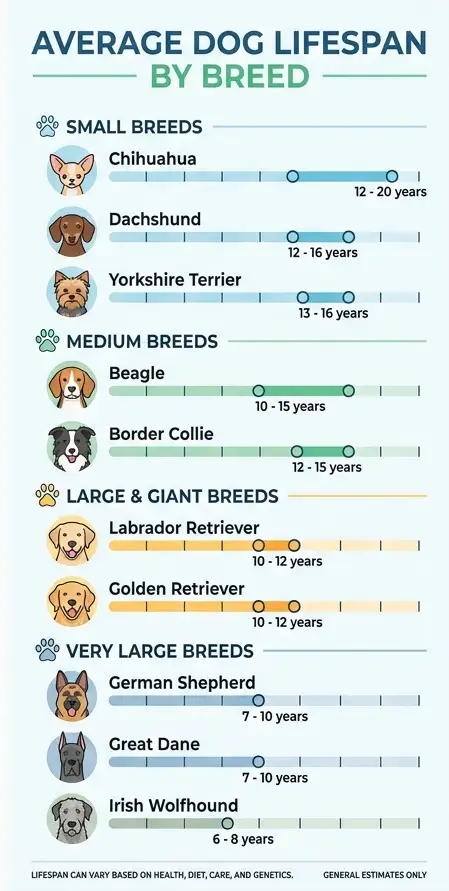
Breed Longevity Records: The Dogs That Lived Longest
Every breed has produced individual dogs that far exceeded expectations. These records matter because they show what’s biologically possible — and they often point toward the lifestyle factors that extended those lives.
Bluey — Australian Cattle Dog — 29 years, 5 months
The longest-verified dog lifespan on record. Bluey was a working farm dog in Victoria, Australia, who spent his entire life herding cattle and sheep. Active, lean, and working daily until near the end. His record has stood since 1939.
What this suggests: Consistent physical work, lean body weight, purpose-driven activitySpike — Chihuahua — 23 years (as of 2024)
A Chihuahua named Spike from Ohio was reported to be 23 years old in 2024, pending official Guinness World Records verification. The Chihuahua breed produces more ultra-long-lived individuals than almost any other, with multiple confirmed cases exceeding 20 years.
What this suggests: Small breeds carry a genuine biological advantage in maximum possible lifespanMaggie — Australian Kelpie — reportedly 30 years
An Australian Kelpie named Maggie was reported to have lived 30 years, though Guinness could not verify as original paperwork was unavailable. Like Bluey, she was an active farm dog throughout her life.
What this suggests: Working dog breeds from Australia appear disproportionately in extreme longevity casesMax — Beagle — 29 years, 282 days
A Beagle named Max from Portugal was verified by Guinness World Records in 2024 as the world’s oldest living dog. If confirmed at death, he would surpass Bluey’s long-standing record. Significant because Beagles are a medium breed — showing exceptional longevity isn’t restricted to small breeds alone.
What this suggests: Individual genetics can override breed-level expectations significantlyThe Shortest-Lived Breeds — And the Specific Reason Why
Understanding which breeds live shortest — and why — matters whether you own one of these breeds or are considering one. Every breed on this list has a specific, identifiable cause for its shorter life, not simply “being big.”
| Breed | Typical Lifespan | Primary Cause of Short Life | What Owners Can Do |
|---|---|---|---|
| Dogue de Bordeaux | 5–8 yrs | Early-onset heart disease, cancer | Regular cardiac monitoring from age 2; avoid obesity strictly |
| Irish Wolfhound | 6–8 yrs | Dilated cardiomyopathy, bone cancer | Cardiac screening every 6 months after age 3; low-impact exercise |
| Bernese Mountain Dog | 6–8 yrs | Histiocytic sarcoma — extremely high cancer prevalence in this breed | Regular cancer screening; avoid breeding lines with known cancer history |
| Great Dane | 7–10 yrs | Bloat (GDV) and dilated cardiomyopathy | Feed multiple small meals; use slow-feeder bowls; annual cardiac checks |
| Mastiff (English) | 6–10 yrs | Cancer, bloat, joint failure from excess weight | Tight weight control; bloat prevention; joint supplements from puppyhood |
| Bullmastiff | 7–9 yrs | Cancer (lymphoma, mast cell tumors), bloat | Annual cancer screening from age 5; controlled diet and exercise |
| Neapolitan Mastiff | 7–9 yrs | Joint disease, cardiac issues, cancer | Joint support from puppyhood; weight management is critical |
| Saint Bernard | 8–10 yrs | Bloat, cancer, joint problems from size | Bloat prevention; avoid rapid growth in puppyhood; regular joint checks |
| Rottweiler | 8–10 yrs | Osteosarcoma (bone cancer) — one of the most cancer-prone large breeds | Annual exams; watch for unexplained lameness as an early cancer signal |
| English Bulldog | 8–10 yrs | Brachycephalic airway obstruction — lifelong breathing difficulty | Keep lean; avoid heat; surgical airway correction can meaningfully improve quality of life |
If you already own one of these breeds, understanding your dog’s current life stage in detail can help you know when to increase monitoring. Our guide on the stages of a dog’s life explains what’s happening in your dog’s body at each phase — including when giant breeds transition into their senior years much earlier than most people expect.
The Breeds Most Likely to Reach 15+ Years
Certain breeds consistently produce dogs that reach 15, 16, 17, and even 18+ years. These aren’t just small breeds — there’s a clear pattern in what they share.
| Breed | Documented Range | Why They Live Long |
|---|---|---|
| Chihuahua | 14–20+ yrs | Tiny body size, low cancer rates, hearts that age slowly. Multiple verified individuals past 20 years. |
| Chinese Crested | 13–18 yrs | Minimal genetic predisposition to the cancers and heart conditions that limit other breeds. Dental care is the main longevity factor. |
| Rat Terrier | 15–18 yrs | Function-bred working dog with broad genetic diversity. Not heavily inbred for appearance. Regularly overlooked despite data suggesting they outlive most toy breeds. |
| Toy Poodle | 14–18 yrs | Well-bred individuals from healthy lines regularly exceed 16 years. Low cancer rates for their size group. |
| Tibetan Terrier | 15–16 yrs | One of the longest-lived dogs of any breed above 15 lbs. Originated as isolated monastery dogs with minimal external breeding influence for centuries. |
| Jack Russell Terrier | 13–16 yrs | High-energy working dog with minimal structural exaggerations. Function-bred genetics and lean build contribute to remarkable longevity for their energy output. |
| Miniature Pinscher | 12–16 yrs | Sturdy, lean build with few of the respiratory or structural problems that limit other small breeds. Generally low-maintenance health-wise. |
| Lancashire Heeler | 13–15 yrs | A lesser-known British herding breed. Dogs Trust UK data lists it as the longest-lived breed by average across all dogs studied. |
Why the Same Breed Can Live Very Different Lifespans
You might have two Golden Retrievers from the same litter. One lives to 14. The other dies at 8 from cancer. The breed sets a range — not a fixed outcome. Several things explain why individuals within a breed vary so widely:
Breeding Line Matters Within a Breed
Two dogs of the same breed from different breeders can have very different health histories behind them. A Golden Retriever from a line where the parents, grandparents, and great-grandparents all lived past 12 years is starting life in a genuinely different position than one from a line with repeated early cancer deaths. When buying a purebred dog, asking for multi-generational health records is one of the strongest predictors of individual lifespan you can access before a puppy is even born.
Inbreeding Coefficient
Within purebred dogs, the degree to which a dog’s parents share ancestors — called the coefficient of inbreeding — is measurable and directly linked to longevity. Higher inbreeding concentrates both desirable traits and health weaknesses. Breeds maintained with a wider genetic pool tend to produce healthier, longer-lived individuals. This is the same principle that gives mixed-breed dogs a biological edge — without the inbreeding that narrows a purebred population, there are simply fewer inherited weaknesses to accumulate.
Sex Differences Within a Breed
Female dogs consistently live slightly longer than males — on average 6 to 12 months longer across most breeds. This difference is documented across multiple large studies and holds up within individual breeds, not just across the entire population. Whether a dog has been spayed or neutered also interacts with this. For a full breakdown of how aging differs by sex and reproductive status, our guide to why small dogs live longer includes the detailed sex and spay/neuter findings.
How to Know If Your Dog Is Aging Faster Than Expected
Sometimes a dog begins showing signs of aging significantly earlier than their breed’s typical timeline. This isn’t always a sign of illness — but it is worth paying attention to, especially if it happens years before your dog’s expected senior window.
The clearest physical indicators of a dog’s true biological age are visible in their teeth, eyes, coat, and movement. Your dog’s teeth in particular follow a biological clock that reflects actual cellular aging rather than calendar time. If your dog’s teeth look significantly older or younger than their known age would suggest, that’s meaningful information about how fast or slowly they’re actually aging.
For a complete visual guide to reading these signs, our dog teeth age chart walks through exactly what to look for — from bright white puppy teeth all the way through the worn, tartar-heavy teeth of a 12-year-old senior.
What the Breed Lifespan Data Doesn’t Tell You
A breed chart tells you what’s typical. It doesn’t tell you what’s inevitable. Several things the numbers can’t capture:
- Geography changes outcomes. A Labrador in a country with strong veterinary access lives a different life than a Labrador somewhere with limited access to early diagnosis. The UK and US datasets that produce most breed lifespan figures reflect a relatively well-resourced dog-owning population.
- The numbers are moving. Breed health is not static. Brachycephalic breeds like French Bulldogs are seeing welfare-driven breeding reforms that may improve their lifespan data in coming decades. Other breeds are seeing new health conditions emerge as populations change.
- Individual genetics trump breed averages. The most powerful predictor of an individual dog’s lifespan isn’t their breed — it’s their specific genetic inheritance. This is why multi-generational health histories from breeders matter more than any general breed chart.
If your dog is showing signs that concern you — changes in energy, appetite, or behaviour that feel like more than normal aging — our guide on signs your dog is dying of old age helps you understand what’s typical for a genuinely old dog versus what warrants an urgent veterinary conversation.
And if you want to know exactly how old your dog is in human terms adjusted for their breed and size, the senior dog age guide covers this in full — including a breed-by-breed table of when each dog enters their senior years and what that means for their care.
Key Takeaways
- Breed lifespan ranges come from multiple different studies — figures vary by source depending on which dataset was used and which population was measured.
- The longest-lived breeds are dominated by small dogs, but working breeds like the Australian Cattle Dog, Belgian Malinois, and Siberian Husky consistently outperform expectations for their size.
- Flat-faced breeds (French Bulldogs, English Bulldogs, Pugs) live significantly shorter lives than other dogs of the same weight — not because of size, but because of structural breeding decisions.
- Within a breed, breeding line quality and inbreeding coefficient are among the strongest predictors of an individual dog’s lifespan.
- Female dogs live slightly longer than males on average within most breeds — consistently documented across large-scale studies.
- The Bernese Mountain Dog has the highest cancer rate of any breed. The Golden Retriever has the highest cancer death rate among popular large breeds — approximately 60% die from cancer.
- Individual records (Bluey at 29 years, Max the Beagle at 29+ years) show that exceptional genetic individuals can far exceed any breed’s expected range.
Disclaimer: This article is written for general informational and educational purposes only. Breed lifespan figures are averages drawn from published veterinary research and breed health studies; they represent typical ranges for healthy, well-cared-for individuals and should not be interpreted as predictions for any individual dog. Actual lifespan depends on genetics, environment, veterinary care, diet, and many other individual factors. The primary longevity risks listed for each breed reflect commonly documented health concerns and are not a complete health profile. Always consult a licensed veterinarian regarding your dog’s individual health, care needs, and any concerns about their wellbeing.