Everything you need to know — from the science of why dogs age differently, to the signs to watch for, to the care that truly makes a difference.
Your dog used to leap to the door every time you picked up the leash. Now, some mornings, he takes a little longer to get up. His face has gone grey, and his naps have quietly grown longer. You did not notice it happening. But at some point, your dog got older.
The question most people reach for first is: how old is “old” for a dog? If you want a quick estimate, you can use a
dog age calculator to get a starting number. But the full picture is far more interesting — and more useful — than a single figure. There is no single age at which all dogs become seniors. A Great Dane can be a senior at just five years old, while a Chihuahua may not reach that stage until age eleven or twelve. The difference is not just about breed — it comes down to size, biology, gender, genetics, and a few things most pet owners have never been told.
This guide covers everything, from the real science behind why dogs age the way they do, to what to watch for, to how you can make your dog’s later years genuinely comfortable and full.
01
What Does “Senior Dog” Actually Mean?
The word “senior” in veterinary medicine refers to the final life stage of a dog — typically defined as the last 25 to 30 percent of its expected lifespan. It is not a disease. It is not a death sentence. It is simply a signal that a dog’s body is entering a phase where it works differently, and where the care it needs begins to shift.
During this stage, the immune system becomes less efficient, organs work harder to maintain normal function, joints begin to show wear, and the senses — hearing, vision, and smell — gradually become less sharp. A dog can be completely healthy and still be a senior. Many senior dogs are active, bright, and full of life. The label simply means that more attentive care, more frequent vet visits, and some adjustments to daily routine are appropriate.
Key point: “Senior” is a life stage, not a diagnosis. Catching this transition early gives you the best possible chance of keeping your dog comfortable and healthy for many more years.
02
Why Do Larger Dogs Age Faster Than Smaller Dogs?
This is one of the most important questions about dog aging — and one that almost no article explains for everyday readers. In nature, larger animals usually live longer. Elephants outlive mice. Whales outlive dogs. But among dogs, the exact opposite is true: the bigger the dog, the shorter its life.
The answer lies in how fast large dogs grow. A Great Dane can go from a newborn puppy to over 100 pounds in roughly 18 months. That growth rate puts an enormous burden on the body at a cellular level. Scientists have found that rapid growth accelerates a process called oxidative stress — a buildup of cellular damage that accumulates faster than the body can repair it.
Research has also shown that larger dogs experience faster DNA damage over time. Their cells divide more frequently during rapid growth, and each division carries a small risk of error. Those errors accumulate into biological aging. Smaller dogs grow slowly, their cells divide at a more manageable rate, and the body has more time to repair itself along the way.
In the simplest terms: a large dog’s body works harder and faster throughout its entire life. That extra effort comes at a cost — a shorter lifespan and an earlier entry into the senior years.
03
Senior Dog Age by Size: A Clear Breakdown
Size is the single most reliable way to estimate when a dog becomes a senior. The table below reflects what most veterinarians use as a working guide in clinical practice.
Size Category
Typical Weight
Senior Years Begin
Average Lifespan
Small Breeds
Under 20 lbs (9 kg)
10 to 12 years
12 to 16 years
Medium Breeds
21 to 50 lbs (10–23 kg)
8 to 10 years
10 to 14 years
Large Breeds
51 to 90 lbs (23–41 kg)
7 to 8 years
9 to 12 years
Giant Breeds
Over 90 lbs (41 kg+)
5 to 6 years
7 to 10 years
These are general ranges. A dog in excellent health with a good diet and regular vet care may appear younger than its age suggests. A dog that has experienced health issues earlier in life may enter its senior phase a little sooner. These numbers are a starting point, not a fixed rule.
04
Senior Dog Age by Breed: A Detailed Reference
While the size chart is useful, many dog owners want to know about their specific breed. Here is a breed-by-breed guide that gives a far more accurate picture for your individual dog.
Breed
Size
Senior Age Begins
Average Lifespan
Chihuahua
Small
10–12 years
14–16 years
Yorkshire Terrier
Small
10–12 years
13–16 years
Shih Tzu
Small
10–12 years
12–16 years
Dachshund
Small
10–11 years
12–16 years
Pomeranian
Small
10–12 years
12–16 years
Maltese
Small
10–12 years
12–15 years
Beagle
Medium
8–10 years
12–15 years
Cocker Spaniel
Medium
8–10 years
12–15 years
Border Collie
Medium
8–10 years
12–15 years
Bulldog (English)
Medium
7–8 years
8–12 years
Labrador Retriever
Large
7–9 years
10–12 years
Golden Retriever
Large
8–10 years
10–12 years
German Shepherd
Large
7–8 years
9–13 years
Boxer
Large
7–8 years
9–11 years
Rottweiler
Large
7–8 years
8–11 years
Siberian Husky
Large
8–10 years
12–14 years
Doberman Pinscher
Large
7–8 years
10–12 years
Great Dane
Giant
5–6 years
7–10 years
Saint Bernard
Giant
5–6 years
8–10 years
Mastiff
Giant
5–6 years
6–10 years
Newfoundland
Giant
5–6 years
8–10 years
Irish Wolfhound
Giant
5–6 years
6–10 years
Bernese Mountain Dog
Giant
5–7 years
7–10 years
The English Bulldog enters its senior years earlier than other medium breeds because of breed-specific structural and respiratory challenges. Boxers and Dobermans have known predispositions to heart conditions. Always discuss your breed’s specific health profile with your veterinarian.
05
What About Mixed Breed Dogs?
A large number of dog owners have mixed breeds, and this is a question that almost no article addresses — even though it is one of the most commonly searched topics by real dog owners.
Mixed breed dogs often benefit from what scientists call hybrid vigor. When two different genetic lines are mixed, the offspring tend to avoid some of the inherited health problems that plague specific purebred lines. Because of this, mixed breed dogs tend to live somewhat longer on average than purebred dogs of the same size — often by one to two years.
For a practical estimate, start with your dog’s size and weight. A 35-pound mixed breed will likely enter its senior years around 8 to 10 years. A 70-pound mixed breed may begin showing senior signs closer to 7 or 8. Your veterinarian can give a more personalized estimate based on a physical examination and blood work that reflects your dog’s biological age rather than calendar age.
06
Does a Dog’s Gender Affect When It Becomes Senior?
This is a topic that no competitor article mentions at all — yet it is a real and documented factor in how dogs age.
Research and clinical observation consistently show that female dogs tend to live slightly longer than males — on average, by approximately six months to one year, depending on breed and size. Intact male dogs tend to roam more, which increases their risk of injury, accidents, and infections. Hormonal differences also appear to play a role in cellular aging. Spayed and neutered dogs, on average, live longer than their intact counterparts.
In practical terms: a male German Shepherd may begin showing signs of joint stiffness or general slowing around age 7. A female of the same breed may still appear notably younger in energy at the same age. These differences are subtle but real, and they matter when thinking about when to start senior-level monitoring.
What to do: Speak with your veterinarian about whether your dog’s sex and reproductive history should factor into when you begin senior wellness blood panels and more frequent check-ups.
07
Dog Age in Human Years: The Old Rule Is Wrong
Almost every article still uses the “one dog year equals seven human years” rule. It is simple, memorable, and largely inaccurate. Researchers at the University of California San Diego studied how dogs and humans age at a molecular level — specifically, chemical changes to DNA called methylation. What they found was that dogs age extremely fast in their early years, then slow down considerably.
A one-year-old dog is biologically closer to a 30-year-old human than a 7-year-old one. The table below gives a more accurate comparison for general reference.
Dog’s Age
Small Dog
Medium Dog
Large Dog
1 year
~15 human yrs
~15 human yrs
~15 human yrs
2 years
~24 human yrs
~24 human yrs
~24 human yrs
5 years
~36 human yrs
~38 human yrs
~42 human yrs
7 years
~44 human yrs
~47 human yrs
~55 human yrs
10 years
~56 human yrs
~60 human yrs
~70 human yrs
13 years
~68 human yrs
~74 human yrs
~84 human yrs
15 years
~76 human yrs
~83 human yrs
~93+ human yrs
A 7-year-old large breed dog is already the biological equivalent of a person in their mid-to-late 50s. This explains why senior care for big dogs should start far earlier than most people expect.
08
How to Tell If Your Dog Is Entering Their Senior Years
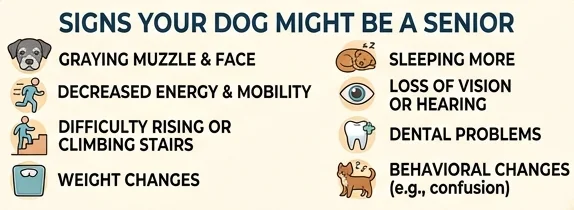
Age on paper is useful. But your dog’s body and behavior will usually tell you the same story — sometimes before the calendar does. These are the most common changes seen as dogs transition into their senior phase.
Greying Fur
The first visible sign for most dogs. It usually begins around the muzzle and face, then gradually spreads. Completely normal and harmless.
Cloudy or Hazy Eyes
A bluish-white haze in the pupil area is often lenticular sclerosis — a normal aging change that does NOT affect vision. Cataracts look similar but do cause vision loss. Your vet can tell the difference.
Lower Energy Levels
Shorter walks, less enthusiasm for play, more time sleeping. A dog that once ran for an hour may now prefer two gentle 15-minute strolls.
Joint Stiffness
Taking longer to stand after resting, hesitating at stairs, or seeming sore after walks. These are early signs of arthritis — very common and very manageable.
Weight Changes
Weight gain from a slower metabolism is common. Unexplained weight loss is always worth investigating promptly — it can signal kidney disease, dental pain, or other conditions.
Hearing or Vision Loss
Not responding to its name, being startled when approached from behind, or bumping into furniture are all possible signs of decline.
Changes in Thirst
Drinking significantly more water and urinating more frequently can be early signs of kidney disease or diabetes — both respond well to early treatment.
Behavioral Shifts
Seeming confused, withdrawn, anxious at night, or less interested in family interaction. These can be signs of Canine Cognitive Dysfunction — the dog version of dementia.
Not every dog will show every sign. The key is to pay closer attention from the time your dog enters its expected senior window — even if everything looks completely normal.
09
Common Health Conditions in Senior Dogs
Senior dogs are more vulnerable to certain conditions. Understanding what these are and which breeds face the highest risk allows you to act early — which is almost always the difference between a manageable problem and a serious one.
Condition
Common Signs
Highest Risk Breeds
Early Detection
Arthritis & Joint Disease
Stiffness, limping, reluctance to jump or use stairs
German Shepherd, Lab, Rottweiler
Physical exam, X-rays
Dental Disease
Bad breath, difficulty eating, pawing at mouth
All breeds, especially small dogs
Dental exam every 6–12 months
Kidney Disease
Increased thirst, frequent urination, weight loss
All breeds over 7 years
Blood panel + urine test
Heart Disease
Coughing, breathing difficulty, swollen belly
Cavalier, Doberman, Boxer
Heart exam, blood pressure
Cancer
Unexplained lumps, weight loss, lethargy
Golden Retriever, Boxer, Bernese
Routine physical exam, blood work
Diabetes
Excessive thirst, weight loss despite good appetite
Overweight dogs of any breed
Blood glucose, urine glucose
Cognitive Dysfunction
Confusion, pacing at night, indoor accidents
All breeds over 10 years
Behavioral assessment at vet visit
Hypothyroidism
Weight gain, hair loss, lethargy, cold intolerance
Golden Retriever, Doberman, Boxer
Thyroid blood panel
A Word About Dental Disease Most Articles Miss
Dental disease is consistently underestimated by dog owners. It is not just about bad breath. Bacteria from infected gums enter the bloodstream and can cause real damage to the heart valves, kidneys, and liver over time. A senior dog with untreated periodontal disease is dealing with a systemic health problem — not just a mouth problem. If your dog has bad breath, is dropping food, or is reluctant to chew, a dental examination is important, not optional.
10
Canine Cognitive Dysfunction: What Dog Dementia Looks Like
Canine Cognitive Dysfunction, or CCD, is one of the most significant conditions in senior dog health — and one that is almost completely ignored in most popular articles on this topic. CCD affects a very large proportion of dogs over the age of 10, and most owners mistake its symptoms for ordinary “slowing down.”
CCD happens because the brain undergoes physical changes with age. Certain proteins accumulate in brain tissue, nerve cells become less efficient at communicating, and blood flow to the brain decreases. The result is a dog whose thinking and perception begin to change — not because of stubbornness, but because of a medical condition.
Veterinarians use the acronym DISHA to help owners identify the core signs of CCD.
D
Disorientation
Your dog gets lost in familiar rooms, stares at walls, stands in corners, or seems confused about where it is. It may not recognize familiar routes on walks it has taken hundreds of times.
I
Interactions
Changes in how your dog relates to you and others. It may become unusually clingy, or alternatively seem detached and uninterested in people it used to greet with enthusiasm every day.
S
Sleep
The sleep-wake cycle shifts. Your dog sleeps heavily through the day but becomes restless, whiny, or agitated at night — sometimes pacing for hours. This is distressing for both the dog and the family.
H
Housetraining
A dog reliably housebroken for a decade begins having indoor accidents. This is not defiance. It is a symptom. The dog has lost some ability to register and respond to the signals its body sends.
A
Activity
Your dog’s interest in the world around it fades. It stops seeking play and responding to its toys. It may stare at nothing for long periods. General engagement with daily life decreases noticeably.
Important: CCD is not curable, but it is treatable. Medications, dietary supplements, and changes to the home environment can meaningfully slow progression and improve quality of life. Do not dismiss these signs as “just getting old” — bring them to your vet’s attention as early as possible.
11
What to Feed a Senior Dog: Nutrition That Actually Matters
Switching to a bag labeled “senior formula” is not necessarily the answer — and some senior formulas on the market are not appropriate for all older dogs. Understanding what your senior dog actually needs nutritionally is more important than any label.
The Protein Myth — Debunked
A widely believed but outdated idea is that older dogs need less protein to protect their kidneys. This is not supported by current veterinary science for healthy senior dogs. In reality, muscle mass naturally decreases as dogs age, and high-quality protein is essential for slowing this muscle loss. The protein myth originated from studies on dogs with existing kidney disease — not healthy aging dogs. For healthy senior dogs, prioritize quality protein, not less of it.
Nutritional Factor
What Senior Dogs Need
Why It Matters
Calories
Slightly reduced overall
Lower activity means easier weight gain; obesity strains joints and organs
Protein
High quality, maintained or increased
Preserves muscle mass that naturally declines with age
Omega-3 Fatty Acids
Increased — through food or supplements
Supports joint health, brain function, coat condition, and heart health
Antioxidants (Vit E & C)
Higher than adult formula
Helps the immune system, which becomes less efficient with age
Sodium
Reduced
Excess sodium puts strain on kidneys and heart — common concerns in senior dogs
Glucosamine & Chondroitin
Added through food or supplement
Supports cartilage in ageing joints; reduces discomfort from arthritis
Fiber
Adequate, not excessive
Digestive health can slow in senior dogs; adequate fiber supports gut function
Water
Always freely available
Kidney function depends heavily on adequate hydration in senior dogs
Always consult your vet before making significant dietary changes. Senior dogs with kidney disease, heart disease, diabetes, or liver conditions have specific nutritional requirements that a standard “senior food” may not meet — and could even worsen.
12
Exercise for Senior Dogs: How Much Is the Right Amount?
Regular movement is one of the most important things you can do for a senior dog’s health. It keeps joints lubricated, maintains muscle mass, supports a healthy weight, and stimulates the mind. The key is adapting exercise to what your dog can genuinely enjoy without pain or exhaustion.
Most senior dogs do best with two to three shorter walks daily rather than one long walk. Signs that exercise is too much include limping during or after the walk, reluctance to move the next day, excessive panting, or whimpering when rising after rest. If you see these signs, reduce the duration and pace and speak with your vet.
Swimming is one of the best forms of exercise for arthritic senior dogs because it provides full cardiovascular and muscle benefits with almost no pressure on the joints. Many rehabilitation veterinarians recommend hydrotherapy as a regular part of managing arthritis in senior dogs.
Mental exercise matters just as much. Short training sessions with simple commands, scent work in the garden, puzzle feeders, and sniff-focused walks all keep the brain active and reduce anxiety-related behaviors in older dogs.
13
Home Environment Changes That Make a Real Difference
Small changes to your home layout and furniture can dramatically improve your senior dog’s daily comfort, safety, and confidence — especially as mobility and sensory abilities decline. This is one of the most practical and most overlooked areas in senior dog care.
Home Adjustment
Why It Helps
Best For
Ramps or pet steps
Lets dogs access the sofa or bed without jumping, which can injure arthritic joints
All senior dogs, especially those with arthritis or spinal issues
Orthopedic memory foam bed
Distributes body weight evenly, relieving pressure on sore joints during long rest periods
Large breeds, dogs with arthritis
Non-slip rugs on smooth floors
Prevents slipping and falling, which senior dogs with weakened hindquarters are prone to on hardwood or tile
Large and giant breeds, dogs with hip or spine issues
Raised food and water bowls
Reduces neck and shoulder strain during eating — particularly helpful for large dogs and those with cervical arthritis
Large and giant breeds
Night lights in hallways
Helps dogs with vision loss navigate safely after dark, reducing risk of falls
Any senior with cataracts or vision decline
Baby gates on stairs
Prevents falls in dogs that struggle to judge step depth or have weakened rear limbs
Dogs with mobility challenges
Consistent furniture layout
Dogs with CCD or vision loss rely on spatial memory; moving furniture frequently causes confusion and anxiety
Dogs with cognitive decline or vision loss
14
The Emotional Health of Senior Dogs: An Overlooked Priority
No competitor article on this topic addresses this at all. Yet the emotional and psychological wellbeing of a senior dog is genuinely important — and it changes as dogs age in ways that owners frequently miss entirely.
Senior dogs can experience something very close to depression, anxiety, and loneliness. A dog that once had an active life can feel a loss of stimulation and purpose as things slow down around it. This is especially true when physical limitations prevent the dog from doing things it once loved.
Signs of Emotional Distress in Senior Dogs
Watch for withdrawing from family interaction, loss of interest in activities or toys the dog previously loved, changes in appetite not explained by a medical condition, excessive grooming or licking, prolonged periods of flat or withdrawn behavior, and increased dependence or clinginess.
What Actually Helps
What senior dogs find most comforting is often the simplest things: your calm presence, a hand resting on them while you read, regular gentle grooming, predictable daily routines, and slow walks where they can take their time sniffing. The nose is often the last sense to decline, and scent-based activities provide enormous satisfaction for a senior dog that can no longer run or play hard.
When a Senior Dog Loses a Companion
Dogs form genuine bonds with other animals in the household. When a companion dog or cat passes away, senior dogs can experience something that behaviorally looks very much like grief: reduced appetite, lethargy, searching behavior, and visible sadness. Maintain as much routine as possible, provide extra gentle company, and give the dog time. If the grieving seems prolonged or severe, speak with your veterinarian.
15
Veterinary Care for Senior Dogs: How Often and What Happens
Once your dog enters its senior years, the standard once-a-year vet visit is no longer enough. Most veterinarians recommend at least two wellness visits per year for senior dogs — and more frequently for dogs already managing a health condition.
Conditions common in senior dogs can develop and change quickly. A problem detected at a six-month check-up has a far better chance of being managed successfully than one discovered at a 12-month visit when it may have progressed significantly.
Screening / Test
What It Detects
Recommended Frequency
Complete blood count (CBC)
Anemia, infection, immune system changes
Annually, ideally twice a year
Blood chemistry panel
Kidney function, liver function, blood sugar, proteins
Annually, ideally twice a year
Thyroid test (T4)
Hypothyroidism — very common in senior dogs
Annually
Urinalysis
Kidney function, diabetes, urinary tract infection
Annually, more often if kidney disease suspected
Blood pressure measurement
Hypertension — common in senior dogs, damages eyes and kidneys if untreated
Annually
Dental examination
Periodontal disease, tooth loss, oral masses
Every 6 to 12 months
Physical examination
Weight, lymph nodes, organ size, joint mobility, eye and ear health
Every 6 months
X-rays (chest and/or joints)
Arthritis severity, heart enlargement, lung changes, hidden tumors
As recommended by your vet
Do not wait for symptoms before scheduling senior blood work. Many serious conditions — including kidney disease and hypothyroidism — produce no obvious outward signs until they are already significantly advanced. Blood panels catch them early, when treatment is simplest and most effective.
16
Super Senior Dogs: When a Dog Outlives Expectations
The term “super senior” is used by some veterinarians to describe a dog that has lived meaningfully beyond its breed’s expected lifespan. The 15-year-old Labrador. The 14-year-old Golden Retriever. The Great Dane that defies everything and reaches age 11. These dogs exist, and they are remarkable.
Super senior dogs benefit from the gentlest possible exercise — very short, slow walks and light indoor movement. Pain management often becomes a daily priority. Soft, easily chewed foods become important if dental health has significantly declined. Warmth and comfort matter more than ever: arthritic joints suffer more in cold environments, and older dogs lose their ability to regulate body temperature efficiently.
Veterinary monitoring for super senior dogs ideally moves to monthly check-ins for dogs showing significant health changes — not because something is immediately wrong, but because changes can happen quickly. If your dog has become a super senior, you are clearly doing something right. Keep doing it.
17
Quality of Life: The Most Important Conversation in Senior Dog Care
This section is the hardest to write — and the one most articles avoid entirely. But it is the one that matters most when a dog is genuinely old or seriously unwell.
Veterinarians use quality of life assessments to help owners think honestly through how a senior or ill dog is truly experiencing its days. The goal is not to count symptoms or check boxes. It is to consider the whole picture — what still brings comfort, what causes pain, and whether the balance between the two is sustainable.
A simple framework many vets recommend is to ask yourself honestly: Is my dog eating and drinking well? Is my dog able to move around without constant pain? Does my dog still have moments of engagement, interest, or pleasure? Does my dog recognize me and the people it loves? Does my dog have more good days than difficult ones?
When the answers to most of these questions shift from yes to no — particularly when pain cannot be adequately managed and basic comfort cannot be reliably maintained — it may be time to have an honest conversation with your veterinarian about what the kindest path forward looks like. Knowing what to watch for, staying in regular contact with your vet, and giving yourself permission to have these conversations is one of the most loving things you can do.
The Bottom Line for Every Dog Owner
There is no universal age at which every dog becomes a senior. The right answer for your dog depends on its size, breed, sex, genetics, lifestyle, and health history. What matters far more than the number is staying attentive to your dog’s changing needs and keeping your veterinarian actively involved.
The senior years are not an ending. For many dogs and their owners, they are among the most meaningful time spent together — quieter, slower, deeper. Full of the kind of closeness that only comes from years of genuine companionship. Your dog gave you its best and fastest years without reservation. Its senior years are simply your chance to give a little more in return.
Disclaimer
This article is written for general informational purposes only and does not constitute veterinary medical advice. Always consult a licensed veterinarian for guidance specific to your dog’s individual health needs and circumstances.